Harvard yard, p.1
Harvard Yard, page 1
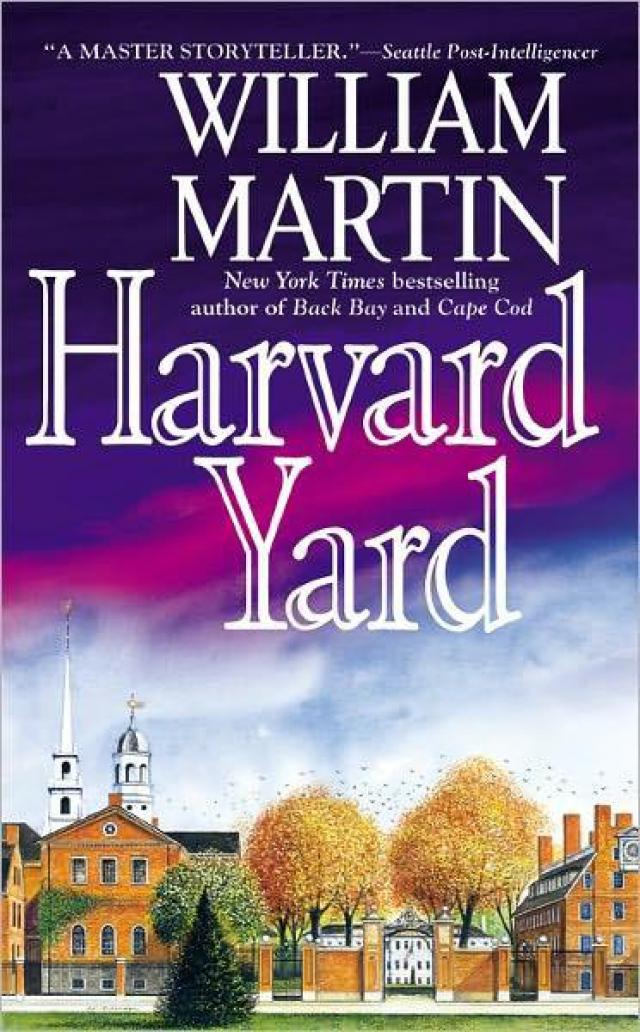


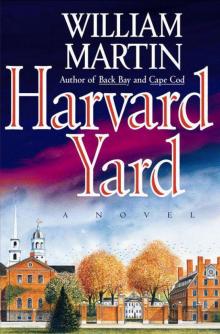
“People came from all over the world to see it, as if it were another Plymouth Rock or Vatican. Peter Fallon understood. It was the beginning of things and the center of things, too… rich, full of itself … and full of intrigue.”
A tale of families, rebellion, war, and devotion, William Martin’s new novel chronicles the life of America’s most revered university and the real men and women who made Harvard what it is today. It is also the riveting story of a high-stakes treasure hunt… for “a small gift of majestic proportion.”
From the year it was established on the edge of the American wilderness—funded by a quarter of the colony’s tax levy and a gift from one remarkable man—Harvard lived in the eye of a ceaseless storm: a profound conflict between ignorance and enlightenment, faith and reason, elitism and equality. Now, three hundred years later, Peter Fallon—the hero of William Martin’s bestselling novel Back Bay—has found evidence that an undiscovered Shakespeare play is hidden somewhere at the college. An antiquarian who knows many of Harvard’s carefully guarded secrets, Fallon understands the powerful implications of the discovery. But as he sorts through the school’s past, from witch hangings to the fires of the Civil War to the riotous 1960s, he realizes that men and women have risked death, disgrace, and banishment for the very secret he is seeking. As Fallon relives conflicts between generations, families, friends, and lovers, he begins to understand something else: that finding this treasure is a matter of life and death.
Following the destiny of one family from the first class of Harvard to the present day, HARVARD YARD is a brilliant work of historical fiction, a beguiling mystery, and an extraordinary saga of the shaping of the American mind.
WILLIAM MARTIN, himself a graduate of Harvard, is a native of Boston, and the author of Citizen Washington, Annapolis, Cape Cod, Back Bay, The Rising of the Moon, and Nerve Endings. He lives in the Boston area.
Author of Back Bay and Cape Cod
$25.95 HPT ($36.95 in Canada)
JACKET ILLUSTRATION BY WENDELL MINOR
HAND LETTERING BY DAVID GATTI
WARNER BOOKS
AN AOL TIME WARNER COMPANY • 0-446-53084-0
COVER PRINTED IN U S A © 2003 WARNER BOOKS
This book is a work of historical fiction. In order to give a sense of the times, some names or real people or places have been included in the book. However, the events depicted in this book are imaginary, and the names of nonhistorical persons or events are the product of the author’s imagination or are used fictitiously. Any resemblance of such nonhistorical persons or events to actual ones is purely coincidental.
Copyright © 2003 by William Martin
All rights reserved.
Warner Books, Inc., 1271 Avenue of the Americas, New York, NY 10020
Visit our Web site at www.twbookmark.com.
An AOL Time Warner Company
Printed in the United States of America
First Printing: October 2003
10 9 8 7 6 5 4 3 2 1
Library of Congress Cataloging-in-Publication Data
Martin, William
Harvard Yard / William Martin,
p. cm.
ISBN 0-446-53084-0
1. Shakespeare, William, 1564-1616—Manuscripts—Fiction. 2. Manuscripts—Collectors and collecting—Fiction. 3. Harvard University—Fiction. 4. Cambridge (Mass.) —Fiction. 5. Boston (Mass.) —Fiction. I. Title.
PS3563.A7297H37 2003
813*.54-dc21 2003012329
HARVARD YARD
by
WILLIAM MARTIN
WARNER BOOKS
An AOL Time Warner Company
in memory of
my father
1915-2001
The oldest trees give the best shade.
Acknowledgments
=========
I can remember thinking, in my last semester at Harvard, back in 1972, that just as I was beginning to figure the place out, they were showing me the door.
I returned to Harvard, in more ways than one, to write this book and continue the process of figuring out an institution of modern complexity built upon a foundation of ancient tradition. Many people were willing to help me bring form to the contours of Harvard history, accuracy to the details of Harvard life, and insight into the workings of Harvard itself.
My thanks to Scott Abell, former President of the Harvard Alumni Association; Michelle Blanc, also of the Alumni Association; Lisa Boudreau, Director of Development and Corporate Relations; Beth Brainerd, Director of Communications at the Harvard libraries; Charles Collier, Senior Philanthropic Advisor; Reverend Peter Gomes, Plummer Professor of Christian Morals, whose Religion 1513 explores the breadth of Harvard history; Sandra Grindlay, Curator of the Harvard Portrait Collection; Scott Haywood, Superintendent of Kirkland House; Leslie Morris, Curator of Manuscripts at Houghton Library; Terry Shaller of the Alumni Association; Stephen Shoemaker, instructor in Religion 1513; Deborah Smullyan of Harvard magazine; and my son Dan and his friends in the Class of 2004, who gave me a few glimpses of undergraduate life.
Thanks also to Linda Ayres, James Banfield, David Case, Gary Goshgarian, Christopher Keane, Lois Kessin, William Kuntz, and John Spooner.
Special thanks to Peter Drummey, Librarian of the Massachusetts Historical Society, for his enthusiastic assistance with every question and research problem; to Conrad Wright, classmate and Director of Publications at the Massachusetts Historical Society, who first suggested that I explore the relationship between Shakespeare and the Harvard family; and to antiquarian Martin Weinkle, for his willingness to share his insights into the world of rare books. Thanks to my editors, Jamie Raab and John Aherne; and to all my friends at Warner Books, who have been publishing me for fifteen years, including Larry Kirshbaum, Maureen Egen, and Harvey-Jane Kowal; to Wendell Minor, whose cover art has graced so many of my books; and to my agent, Robert Gottlieb.
And as always, thanks to my wife and all my children, who continue to serve as research assistants, proofreaders, opinion-givers, and general inspirations.
WILLIAM MARTIN
June 2003 .
HARVARD
YARD
Chapter One
==========
1605-1637
ROBERT HARVARD went often to Stratford-on-Avon, but never before had he gone with such trepidation. Never before had the sight of the tower at Guild Chapel turned his stomach to jelly, nor the sound of his horse’s hooves upon Clopton Bridge given him such cause to turn and ride the whole eighty miles back to London.
Ordinarily, he went to buy cattle, for he owned a butcher shop, and the farmers of Warwickshire raised the fattest cattle in England, and a butcher without cattle was like a tailor without cloth. But on this August afternoon, Robert Harvard went to seek a wife, for he was also a man, and a man without a wife was like a butcher without cattle, or a tailor without cloth, or a playwright without a stage… . And that, he thought, was a string of metaphors to charm the birds from the trees. … Or were they similes?
No matter. Will would know. Will would calm him, too, and give him the confidence to court a young woman as beautiful as Katherine Rogers. Of that he was certain. So, once across the river, Robert Harvard made for the rambling big house known as New Place. Will would tell him which of his words would work best.
Will would also tell him the difference ‘twixt a metaphor and a simile.
” ‘A butcher without cattle?” cried Will Shakespeare. “You call that an image of love? You call that poetry? Or ‘a tailor without cloth?”
“Well … what of ‘a playwright without a stage?” asked Harvard in his strong Southwark accent.
“You court a wife, man, not a cutler. Sharpen your wit with soft words.”
“Soft words? Words like … like featherbed?”
“Aye, featherbed” said Will. “Featherbeds are soft. Pudding is soft. The dung that manures my roses is soft. But we speak here of a woman’s heart.
“Shakespeare was forty-one and far heavier than when first he appeared in Harvard’s butcher shop some fifteen years before, a young man come to London hungry for fame but hungrier still for sausage or beef suet or even a marrow bone to fill his belly. Now, his face had filled and his belly had settled, as happened with most men whose purses had filled and whose lives had settled. But when he moved, Will Shakespeare was ever the actor, shaping each gesture and step to the role he played. And the role of the moment was poet.
He pushed open the windows of the great room and gazed out at his roses. He did not ruminate or pace upon the polished stone floor. His poetry came quickly. He gazed, he thought, and he said, ” Tis a beautiful day, Rob.”
“Aye.” Rob clasped his hands behind his back, then folded them in front of himself, then rested one on the hilt of his dagger and the other on his belt. Though he owned property in London, served as a warden in his church, and could afford to dress for courtship in a fine crimson doublet of crushed velvet, he still had the hands of a tradesman—big and coarse and never at ease unless holding a tool.
” ‘Tis a beautiful summer’s day,” said Shakespeare.
“Aye.”
“Were I in your place, I’d say to her, ‘Shall I compare thee to a summer’s day?’ “
“A summer’s day, Will. Yes… ‘Tis warm … and soft.”
“Indeed. ‘Thou art more lovely and more … more—’”
“Temperate?” Robert Harvard offered a word that sounded eloquent.
“Temperate” —Shakespeare counted the syllables on his fingers—” ‘Thou art more lovely
And on he went, composing a sonnet to the fleeting beauty of summer and the solid nature of Robert Harvard’s love.
” ‘So long as men can breathe or eyes can see. So long lives this’—the sonnet, I mean—’so long lives this, and this … this gives life to thee.’ ” With a flip of his hand and a little bow, Will was done.
“Soft words for Katherine Rogers.”
Too many words, thought Robert Harvard, and too many metaphors… or were they similes? But who was he to question a man whose poetry had earned him that handsome house and beautiful garden?
“Many thanks, Will. Courtship never come easy, even to a man of thirty-five.”
“She’s an angel, Rob … reed slender, to be sure, but still an angel.
“And I be a mere mortal, widowed once and wantin’ a new wife.”
“You’ve been an angel to many a hungry actor.”
” ‘Twas only what a Christian should do.”
“There were Christians aplenty who denied victuals to this glover’s son. But you gave him to eat. So”—Will gripped Robert’s shoulders—”screw your courage to the sticking place, as we say.
Speak to her father, then go to Katherine and tell her of a love as warm as a summer’s day.”
“Would that you’d stand aside me, Will, and whisper these words in me ear.”
” ‘Tis for you to do yourself, Rob. And you’d not want me whispering in your ear on a day when malevolence whispers in mine.”
“Malevolence?”
“By the name Iago, servant to the blackamoor Othello. He has deranged Othello with his lies.” The excitement danced on Will’s face, and malevolence crept into his voice. “Othello is about to strangle his flaxen-haired wife in a fit of jealous rage. He wraps his hands round her neck and—” Will calmed himself, as if his imagination were a pitcher full to the brim, from which he could afford to spill only a little. “So, then … you to your muse, and I to mine.”
” ‘Shall I compare thee to a summer’s day?’ ” Robert Harvard repeated the words as he walked from New Place to the Rogers home in High Street.
A temperate summer’s day. On such a day, how could a man see deranged Moors strangling flaxen-haired women? Playwrights were foreign creatures altogether, he thought, that they could imagine such things and not themselves be deranged. He tried to banish these dark visions, but he feared to lose the better images Will had put into his head, as when we seek to banish the thorn, we lose also the petal. So he turned his mind to the bouquet of roses he had cut in Will’s garden and to the thorn pricking his finger.
The house of Thomas Rogers was one of the finest in Stratford, rising in three half-timbered stories, with great windows flung open on every floor. Rich man’s windows they were, overlooking a street wider and more welcoming than any in London. And there was no man in London or Stratford more welcoming than Thomas Rogers, alderman and cattle broker.
Next to cattle, good cheer was his stock-in-trade, but what man would lack for good cheer who profited from Warwickshire beef and ate it, too? His good cheer grew even greater when he learned the purpose of Harvard’s visit, for Rogers had seven daughters, and the girl in question had reached the ripe old age of twenty-one without a husband.
It did not surprise Robert, then, that they settled on a dowry more quickly than ever they had settled on a price for cattle. It did surprise him, however, that Rogers would honor the bargain only if the girl went willingly to marriage.
“Willingly … aye,” said Robert, “or not at all.”
He found Katherine in the garden, in a shaft of golden sunlight, and the shimmer of her flaxen hair caused him to forget all the words Will Shakespeare had given him. He nearly forgot his own name.
“Why, Master Harvard,” she said, “‘tis pleasure to see you.”
Rob reached for Will’s words, but the first image he found was of a deranged Moor, fingers twined round the neck of his flaxen-haired wife, an image to be banished yet again. And just as he feared, Will’s soft words went with it, so that he could only stammer, 1… 1…
“Roses?” said Katherine. “Roses are a joy.”
“Yes.” And now he found a few of Will’s words, hiding in his memory … old words, but good ones, and soft, spoken by the character of Romeo. “Roses they are, miss, but… that which we call a rose, by any other name would … would …”
“Smell as sweet?”
“Yes … though not so sweet as you, miss.” And that, he thought, was well said.
In taking the roses, she noticed the blood on his fingertip. “Why, good sir, you bleed for me? How noble.” And gently she touched him.
His hand trembled at her touch, and yet did her touch itself tremble, which he found strangely calming, for it meant that she was as nervous as he … and perhaps as willing. And a small measure of his wit returned. He said, “I bleed for love, miss.”
And she said, “I yearn for it.”
And Rob found a few of Will’s softer words to speak. “I bleed willingly for love, on a … a summer’s day.”
” ‘Tis a fine summer’s day that Robert Harvard brings me roses.”
“A temperate summer’s day.” And then did his wit return in full.
“I promise many more, even when the cold December of our lives has been lived to the solstice, even then shall I find a final summer’s day with thee, miss, should you say yes to marriage.”
And her smile spoke more eloquently than all the words that Will Shakespeare had ever written.
Two years later, if one were to ask Robert Harvard the season, he would say “summer,” no matter the angle of the sun, for no northern blast could cool the summer he knew in the bed of Katherine Harvard, a rose even sweeter now that she bore his name.
And no day was more June-glorious to him than the damp November afternoon when he and Katherine brought their firstborn son to St. Saviour’s in Southwark. Robert Harvard would never know with greater certainty of God’s love or his own immortality than at the moment when the tiny head was held over the font and the spirit-cleansing water poured down. Nor would he ever know better that the love of his fellow man reflected God’s love than on that night, when friends and neighbors went to the Queen’s Head Inn to celebrate the birth of the baby named John.
As Robert Harvard was a part owner of the inn, the presence of the babe brought no scandal to the taproom. In truth, there was little that happened on that side of the Thames that could cause Southwark to appear more scandalous than it already was.
City fathers reigned on the north bank, but their power did not cross the twenty-arch bridge. So here would be found prostitutes in their stews, selling favors to pay rents to the corrupt bishop of Winchester. Here cutpurses thrived in alleys, and convicts served in Clink. Here animal baiters brought beasts to fight in the pits, and when the beasts were killed, the baiters learned new skills from convicts and cutpurses, too. And here, performing by day in the theaters, carousing by night in the taprooms, were the actors.
But here also the bell tower of St. Saviour’s rose like a father confessor above his sinners. And here men like Robert Harvard, men of business and sometimes of property, saw sin for what it was and rose above it, too, though Robert believed in the Lord’s admonition that “what you do for the least of my brethren, you do for me.” So on that night of celebration, he opened the tap for all and asked payment of none.
Most brought good wishes. A few brought gifts of silver coin.
Others brought no more than their thirst. But one, who came in from the cold wearing a cape trimmed in rabbit fur, brought a gift of paper and leather that would prove more valuable than gold.
Will Shakespeare elbowed through the crowd, neither expecting nor offering ceremony to those who greeted him with shouts and handshakes and resounding slaps upon the back.