3 rays, p.1
3 Rays, page 1


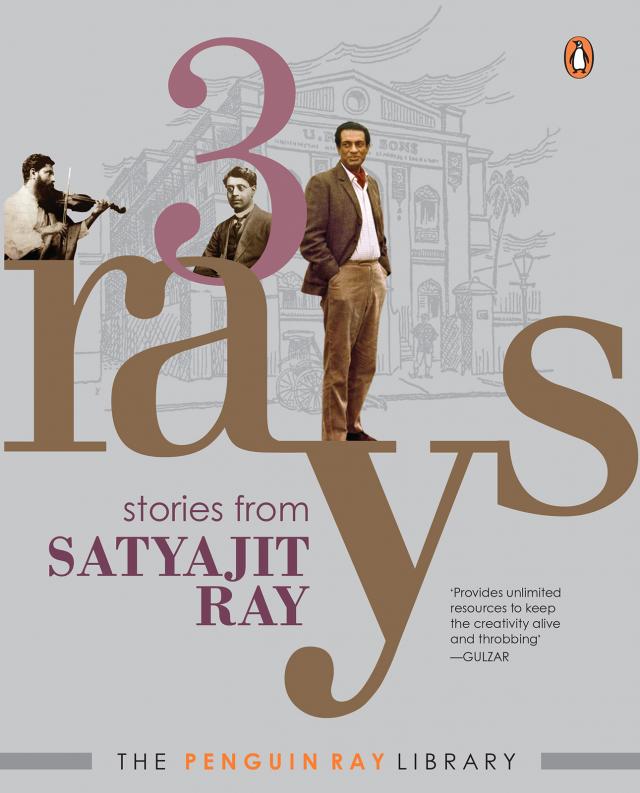
SANDIP RAY
3 Rays
Stories from Satyajit Ray
Co-edited by Riddhi Goswami
Layout and design by Pinaki De
The Penguin Ray Library
PENGUIN BOOKS
CONTENTS
Foreword by Sandip Ray
SATYAJIT TRANSLATES UPENDRAKISHORE
Upendrakishore
Majantali Sarkar
The Toony Bird
Narahari Dass
The Bent Old Woman
The Ant, the Elephant and the Brahmin’s Servant
The Tiger in the Cage
Goopy Gyne—A Tale of Two Illustrators
Film treatment of Goopy Gyne Bagha Byne
SATYAJIT TRANSLATES SUKUMAR
Sukumar
Stew Much!
The Old Woodman
The Missing Whiskers
Old Tickler
Uncle’s Invention
The Sons of Rangaroo
Prey for Me
The Pundit’s Wrath
Baburam the Snake Charmer
The King’s Illness
The King of Bombardia
Groomy Tidings
Odour in the Court
The Diary of Prof. Heshoram Hoshiar
SATYAJIT TRANSLATES SATYAJIT
Satyajit on His Literary Works
Bonkubabu’s Friend
The Small World of Sadananda
Patolbabu, Film Star
Bipin Choudhury’s Lapse of Memory
Professor Shonku and Khoka—Draft Script
Night of the Indigo
The Life and Death of Aryashekhar
Magic Box of Baghdad
Ratanbabu and That Man
Fritz
The Sahara Mystery
Corvus
Khagam
The Unicorn Expedition
Tellus
Ashamanjababu’s Dog
Big Bill
Tipu, the Maths Teacher and the Pink Man
The Duel
SATYAJIT’S ORIGINAL STORIES IN ENGLISH
Abstraction
Shades of Grey
Illustrations
Acknowledgements
A Note on the Society for the Preservation of Satyajit Ray Archives
Follow Penguin
Copyright
Foreword
My earliest memories of my grandfather’s (Sukumar Ray) nonsense rhymes and great-grandfather’s (Upendrakishore Ray Chowdhury) folk tales go back to my childhood days—even before I started reading—listening to them from my grandmother every day before she put me to sleep. Later on I became aware of their other contributions in printing, typography, songs and illustrations—primarily through the children’s magazine Sandesh founded by Upendrakishore in 1913 and later edited by Sukumar and then my father, Satyajit Ray. While Upendrakishore was a gifted illustrator and painter, Sukumar illustrated his inimitable nonsense rhymes with his unique sense of imagination. Baba, too, started his writing career in Sandesh, when he revived the magazine in 1961 after a long gap. Soon he became an extremely popular writer for young people, writing detective fiction, science fantasy and other stories bordering on supernatural. Baba took up translation of Sukumar’s and Upendrakishore’s literary works in his leisure time; usually in between shooting of films. It stemmed mainly from his desire to present them to a wider readership. Both Sukumar and Upendrakishore—although being immensely popular in Bengali literature—have not been translated much, and hence practically were little known outside Bengal. It is an interesting fact to note that Baba started translating Sukumar’s nonsense rhymes quite unexpectedly, while waiting at an airport lounge due to a long flight delay. Then there were occasional requests from English periodicals for stories and that is how Heshoram Hoshiar and the folk tales by Upendrakishore got translated. During the post-recovery period from his heart ailment, Baba turned to translation once again because he was stuck for original story ideas, and thus there was a phase where he translated quite a few of his own stories at one stretch.
The present volume is a compilation of some of Sukumar’s and Upendrakishore’s writings translated by Satyajit Ray, along with translations of his own stories. It brings together the diverse literary creations by the three Rays—ranging from simple, innocent folk tales to quirky humour of nonsense rhymes, culminating in the modern world of crime, fantasy and macabre. It also includes Baba’s only two original English stories written during his art apprenticeship days in Shantiniketan in the early forties. During the filming of Goopy Gyne Bagha Byne from his grandfather’s story, Baba made a film version of the story as a prequel to the actual scenario. This previously unpublished piece has been unearthed from his film notebooks along with his sketches and doodles. A few unpublished translations of his own stories have also been recently discovered.
I am grateful to Penguin Random House India for their unstinted support in this endeavour. I especially want to thank Premanka Goswami, executive editor, Penguin Random House India, for his vision to conceptualize ‘The Penguin Ray Library’ and his belief in our project in these trying times.
I sincerely hope that the readers—particularly the present generation non-aficionados of these literary geniuses—will enjoy these timeless classics and go on to discover their original body of work. This book is a rare compilation of three generations of cultural heritage; Satyajit Ray paying homage to his father’s and grandfather’s literary legacy and telling his own stories as well—a fitting tribute on his birth centenary.
1/1 BISHOP LEFROY ROAD
SANDIP RAY
KOLKATA
2021
SATYAJIT translates UPENDRAKISHORE
Portrait of Upendrakishore drawn by Satyajit Ray.
The longhand calligraphy—‘Upendrakishore Ray Chowdhury’ by Ray has been taken from his notebook.
Ray’s illustration of his ancestral house at 100 Garpar Road, Kolkata (Jokhon Choto Chilam, Ananda Publishers, 1982)
UPENDRAKISHORE
The original Bengali essay, written and read by Satyajit Ray at Mahabodhi Society Hall, Kolkata, during the centenary celebration of Upendrakishore, was first published in Prabandha, Puja Annual, 1963. It was translated into English by Indrani Majumdar. The illustrations in the essay are by Satyajit Ray, originally drawn for the book Upendrakishore by Leela Majumder (New Script, 1963). The endpiece illustration is a decorative woodblock bought by Satyajit Ray from Banaras.
I have no personal memory of Upendrakishore; and it’s not possible to have any because he passed away six years before my birth.
The house which he had built on 100 Garpar Road and the same house where he died was also the house where I was born. My childhood was spent in this house and quite a bit of my growing up years were occupied in one particular portion of the building, within which was housed the U. Ray & Sons printing press.
What work was being done in that press, how it was being done, how exactly this press was different from the other such presses—I still wasn’t old enough to understand such logistics. Six years after this business had folded up I left Garpar and went to live in Bhawanipore in a completely different milieu. The only link with U. Ray & Sons that remained was through a few books written by him, a few bound volumes of Sandesh, some of his own drawings and the prints of his paintings.
As I had not had the fortune to meet Upendrakishore and know him personally, perhaps that was why I tried to discover him through his writings and drawings time and again. This quest for discovery is still on. Thanks to the revival of the Sandesh magazine in the recent past, I have had the opportunity to go through the writings and paintings published during his association with Sandesh, once again in detail. While studying his works repeatedly I realized that in the way Upendrakishore had captured the spirit of juvenile literature, he remains matchless even today. And the persona that appears through these paintings and writings, is that of a calm yet vivacious, level-headed and dynamic person who is indeed a rare personality.
If one judges, it can be easily said that in the world of children’s literature there’s none to equal Upendrakishore. The essence of literature along with his charming language that’s found in Tuntunir Boi (The Tailorbird Book), Chheleder Mahabharat (Mahabharata for Young Boys), Chhotoder Ramayan (Ramayana for Children) or in the numerous articles, poems, or stories which have appeared in Sandesh, despite belonging to a genre of literature meant for all, without doubt, every child can enjoy the true spirit of these writings. In Bengal there’s a significant body of children’s writings whose true spirit can perhaps be appreciated only by the adult reader. This holds true in the case of children’s works by writers like Rabindranath, Abanindranath, and even in case of writings by Sukumar Ray and Lila Majumdar. The flavour which you discover reading Ha-ja-ba-ra-la (A Topsy-Turvy Tale) or Buro-Angla (The Big Adventures of a Little Hero) is certainly not the same flavour you enjoy when you read Tuntunir Boi. To appreciate Tuntunir Boi at a mature age you need to awaken the child hidden in your heart.
The magic of Upendrakishore’s writings is the ease with which it stimulates and rouses the innocence of a child’s mind. For how many writers of children’s literature can you say the same?
The two most amazing qualities of Upendrakishore as an artist are his multifacetedness—his versatility, and a successful synthesis of eastern and western art in his talent. He has chiefly produced two kinds of art. One was his favourite oil paintings, the majority of which were landscapes and the other were his illustrations. There is no doubt that his real expertise lay in the oil paintings. I’ve pe
Both content and method mark his oil paintings, but the exact opposite is observed in his illustrations. The poets of East and West spoke of harmony—this comes out alive in all his illustrations. Even if his technique leaned towards the West, the illustrations he used for the Indian stories, did not bear the evidence of western or mixed in influences. And being a scientist himself, even while dismissing anatomy he did not adopt the so-called Oriental style of over imposed embellishments in his drawings. Yet, within this boundary of naturalism, he produced a marvellous range of styles. On the one hand there was the influence of the English academic art, the Japanese woodcut, Rajput and Mughal miniatures, even the use of Bengal folk elements and on the other, the use of extraordinary power of personal observation—in all what Upendrakishore created was discernible a style that was essentially his own. With the result, every time one came across his work one never mistook it as someone else’s. In the first three volumes of his Sandesh, during the last phase of his output, and in the illustrations done for the book Hindustani Upokotha (Folk Tales of Hindustan) compiled by Sita Devi and Shanta Devi, one sees the finest examples of his creativity.
The indispensable relationship which the form and the language share is something that is beautifully reflected in Upendrakishore’s writings. Those who have missed out on reading his articles and essays on science written for children would never get to know how such a difficult subject can be addressed with such lucidity.
This simplicity perhaps highlights all of Upendrakishore’s creative activities. Only after putting in serious efforts, imagination, thoughts, thorough research and intense hard work, can one arrive at this level of effortlessness. Those who are real artists have the capacity to unravel the mysteries of all creative acts. While living in Calcutta, improving on the concept of half-tone block printing, or writing such an exemplary children’s book such as Tuntunir Boi, or composing a song like Jago Purobasi / Bhagavata Prem Piyasi (Awake citizens / those who desire the love of God), it was Upendrakishore who alone was capable of producing such an amazing range of work all by himself.
MAJANTALI SARKAR
First published in the book Tuntunir Boi (U. Ray & Sons, 1910)—a collection of East Bengal (now Bangladesh) folk tales retold by Upendrakishore. Some of the ideas were previously published in articles written by Upendrakishore in the magazines Mukul and Sakha as ‘Biraler Jaat’ (January 1899) and ‘Biral’ (February 1889), respectively. The English translation by Satyajit Ray was published in Target (March 1984). The illustrations in the story are by Upendrakishore Ray Chowdhury. The endpiece illustration is a decorative woodblock bought by Satyajit Ray from Banaras.
In a village there lived two cats. One lived in the milkman’s cottage. He had cream and butter and cheese to eat. The other lived in the fisherman’s cottage. All he ever got was kicks and blows on his head. The milkman’s cat was fat and went about with his head held high. The fisherman’s cat was nothing but skin and bones. He stumbled when he walked and wondered how he could ever become as fat as the milkman’s cat.
One day the fisherman’s cat said to the milkman’s cat, ‘Brother, you must come and dine with me tonight.’
He was only pretending, of course. How could he ask anyone to dinner when he had nothing to eat himself? But he asked him all the same because he thought: ‘If that fat cat comes to our place and is beaten and killed, then I can go and take his place in milkman’s cottage.’ It worked out just as he had thought. As soon as the milkman’s cat came to the fisherman’s place, the fisherman shouted. ‘There! It’s that pampered butterfed cat from the milkman come after our fish!’
He gave the cat such a thrashing that the poor creature finally died. The lean cat knew this would happen, so he lost no time in making his way to the milkman’s. There he stuffed himself with cream and cheese and butter and soon grew fat. He stopped talking to the other cats, and if anybody asked him who he was, he would draw himself up and say, ‘My name is Majantali Sarkar.’
One day Majantali took a pen and a notebook and went for a walk. Strolling in the forest, he came upon three tiger cubs romping about in a clearing. He gave three whoops at them and said, ‘Ho there—pay up your taxes!’ The tiger cubs got very scared at his shouting, and at the sight of pen and paper. They ran up to their mother and said, ‘Mummy, come and look, somebody’s here and is trying to tell us something.’
The tigress came out and saw Majantali. ‘Who are you, my boy?’ she asked. ‘Where are you from? What do you want?’
Majantali said, ‘I’m the king’s manager. My name is Majantali Sarkar. You live in the king’s country. What about taxes? Come on, pay up!’
The tigress said, ‘We don’t even know what taxes are. We only live in the forest and eat what comes our way. Why don’t you wait a while; my husband will be back soon.’
So Majantali sat down below a tall tree and peered around. Soon he spotted the tiger coming. He quickly put his notebook down and clambered up to the topmost branch of the tree.
When the tiger came home, the tigress told him everything. This greatly annoyed him. He gave a nasty growl and said. ‘Where’s that little devil? I’ll catch him and twist his neck.’
Majantali shouted down from the top of the tree. ‘Ho there, Tiger-boy. What about your taxes? Come on out and pay up!’
At this the tiger roared and gnashed his teeth and in mighty leaps was up on a high branch of the tree. But he was still nowhere within reach of Majantali. Being small and light, the cat could sit on the thin top branches, while the tiger couldn’t climb beyond the stout branches lower down. When the tiger found he couldn’t reach the cat, he became wild with rage, gave a leap, lost his footing, and slipped. Plummeting down, his head got caught between two branches, and in no time, he was dead of a broken neck.
When Majantali saw what had happened, he climbed down and drew three scratches on the dead tiger’s nose with his claws. Then he called the tigress and said. ‘Look what I’ve done to him for being so haughty.’
This scared the life out of the tigress. She trembled and said, ‘Please, Mr Majantali, sir, I beg you to spare our lives. We’ll be your slaves for as long as we live.’
‘All right,’ said Majantali, ‘I’ll spare you. But you must work hard and do your chores and feed me well.’
So Majantali lived in the tiger’s den as a guest. He stuffed himself with the best food and rode around on the backs of the cubs. The cubs always lived in fear of him, and thought he must be somebody very big and strong.
One day the tigress folded her palms and said to Majantali. ‘Mr Majantali, sir, the animals in this forest are so small they seldom make a square meal for you. There’s a big forest across the river with big animals in it. Why don’t we all go and settle there?’
Majantali said. ‘Very well, let’s go to the other forest.’
Now it took the tigers no time to swim across the river; but what about Majantali? Ma Tiger and the cubs looked all around for him, and at last spotted him in the middle of the river, flapping his arms about and gasping for breath.
Majantali had been swept away by the strong current, and had nearly lost his life fighting the waves. He could see that a few more waves like that and he would be a dead cat. Just in time one of the tiger cubs swam up and dragged him off to the shore, saving him from certain death.