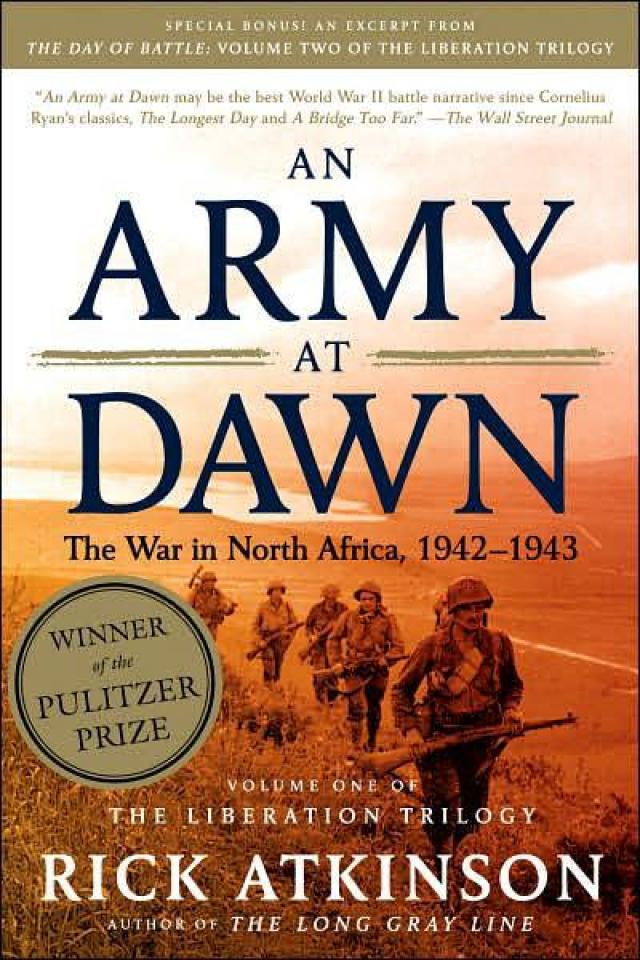
An Army at Dawn

An Army at Dawn

Rick Atkinson

History / Military History / Nonfiction

Amazon.com ReviewIn An Army at Dawn,, a comprehensive look at the 1942-1943 Allied invasion of North Africa, author Rick Atkinson posits that the campaign was, along with the battles of Stalingrad and Midway, where the "Axis ... forever lost the initiative" and the "fable of 3rd Reich invincibility was dissolved." Additionally, it forestalled a premature and potentially disastrous cross-channel invasion of France and served as a grueling "testing ground" for an as-yet inexperienced American army. Lastly, by relegating Great Britain to what Atkinson calls the status of "junior partner" in the war effort, North Africa marked the beginning of American geopolitical hegemony. Although his prose is occasionally overwrought, Atkinson's account is a superior one, an agile, well-informed mix of informed strategic overview and intimate battlefield-and-barracks anecdotes. (Tobacco-starved soldiers took to smoking cigarettes made of toilet paper and eucalyptus leaves.) Especially interesting are Atkinson's straightforward accounts of the many "feuds, tiffs and spats" among British and American commanders, politicians, and strategists and his honest assessments of their--and their soldiers'--performance and behavior, for better and for worse. This is an engrossing, extremely accessible account of a grim and too-often overlooked military campaign. --H. O'BillovichFrom Publishers WeeklyAtkinson won a Pulitzer Prize during his time as a journalist and editor at the Washington Post and is the author of The Long Gray Line: The American Journey of West Point's Class of 1966 and of Crusade: The Untold Story of the Persian Gulf War. In contrast to Crusade's illustrations of technomastery, this book depicts the U.S. Army's introduction to modern war. The Tunisian campaign, Atkinson shows, was undertaken by an American army lacking in training and experience alongside a British army whose primary experience had been of defeat. Green units panicked, abandoning wounded and weapons. Clashes between and within the Allies seemed at times to overshadow the battles with the Axis. Atkinson's most telling example is the relationship of II Corps commander George Patton and his subordinate, 1st Armored Division's Orlando Ward. The latter was a decent person and capable enough commander, but he lacked the final spark of ruthlessness that takes a division forward in the face of heavy casualties and high obstacles. With Dwight Eisenhower's approval, Patton fired him. The result was what Josef Goebbels called a "second Stalingrad"; after Tunisia, the tide of war rolled one way: toward Berlin. Atkinson's visceral sympathies lie with Ward; his subtext from earlier books remains unaltered: in war, they send for the hard men. Despite diction that occasionally lapses into the melodramatic, general readers and specialists alike will find worthwhile fare in this intellectually convincing and emotionally compelling narrative. Copyright 2002 Cahners Business Information, Inc.
Read online
  • 30
Barrel of a Gun

Barrel of a Gun

Al Venter

Journalism / Military History / Politics

In his journeys, Venter associated with an array of similarly daring soldiers and journalists, from “Mad Mike” Hoare to Danny Pearl, as well as elite soldiers from around the world, many of whom, he sadly relates, never emerged from the war zones they entered. The creator of countless documentaries and books, from warfare to shark diving to nuclear proliferation, Al Venter has here offered the reader his own personal combat experiences, in all their multi-faceted fascination.
Read online
  • 19
How Hitler Could Have Won World War II

How Hitler Could Have Won World War II

Bevin Alexander

Military History

Most of us rally around the glory of the Allies’ victory over the Nazis in World War II. The story is often told of how the good fight was won by an astonishing array of manpower and stunning tactics. However, what is often overlooked is how the intersection between Adolf Hitler’s influential personality and his military strategy was critical in causing Germany to lose the war. With an acute eye for detail and his use of clear prose, acclaimed military historian Bevin Alexander goes beyond counterfactual “What if?” history and explores for the first time just how close the Allies were to losing the war. Using beautifully detailed, newly designed maps, How Hitler Could Have Won World War II exquisitely illustrates the important battles and how certain key movements and mistakes by Germany were crucial in determining the war’s outcome. Alexander’s harrowing study shows how only minor tactical changes in Hitler’s military approach could have changed the world we live in today. How Hitler Could Have Won World War II untangles some of the war’s most confounding strategic questions, such as: Why didn’t the Nazis concentrate their enormous military power on the only three beaches upon which the Allies could launch their attack into Europe? Why did the terrifying German panzers, on the brink of driving the British army into the sea in May 1940, halt their advance and allow the British to regroup and evacuate at Dunkirk? With the chance to cut off the Soviet lifeline of oil, and therefore any hope of Allied victory from the east, why did Hitler insist on dividing and weakening his army, which ultimately led to the horrible battle of Stalingrad? Ultimately, Alexander probes deeply into the crucial intersection between Hitler’s psyche and military strategy and how his paranoia fatally overwhelmed his acute political shrewdness to answer the most terrifying question: Just how close were the Nazis to victory? Why did Hitler insist on terror bombing London in the late summer of 1940, when the German air force was on the verge of destroying all of the RAF sector stations, England’s last defense? With the opportunity to drive the British out of Egypt and the Suez Canal and occupy all of the Middle East, therefore opening a Nazi door to the vast oil resources of the region, why did Hitler fail to move in just a few panzer divisions to handle such an easy but crucial maneuver? On the verge of a last monumental effort and concentration of German power to seize Moscow and end Stalin’s grip over the Eastern front, why did the Nazis divert their strength to bring about the far less important surrender of Kiev, thereby destroying any chance of ever conquering the Soviets?
Read online
  • 12
Carried Forward By Hope

Carried Forward By Hope

Ginny Dye

Historical / Historical Fiction / Military History / Civil War

America struggles to rebuild in the aftermath of Lincoln’s assassination. Promises will be broken, and everyone you have grown to love will be asked to pay a high price to make freedom for the slaves more than just a mockery. Robert fights to emerge from the darkness as Carrie risks everything to bring him back to her. Moses is offered the opportunity of a lifetime, while Rose returns to her roots with a dream that will change everything. Matthew is caught up in the worst maritime disaster in American history, while Jeremy discovers the cost of embracing his true heritage. Thomas and Abby are surprised by a future they never dreamed was possible.
Read online
  • 8
Chasing King's Killer

Chasing King's Killer

James L. Swanson

History / Nonfiction / Military History

In his meteoric, thirteen-year rise to fame, Dr. Martin Luther King Jr. led a mass movement for Civil Rights — with his relentless peaceful, non-violent protests, public demonstrations, and eloquent speeches. But as violent threats cast a dark shadow over Dr. King's life, Swanson hones in on James Earl Ray, a bizarre, racist, prison escapee who tragically ends King's life. As he did in his bestselling Scholastic MG/YA books Chasing LIncoln's Killer and "THE PRESIDENT HAS BEEN SHOT!", Swanson transports readers back to one of the most shocking, sad, and terrifying events in American history. Over 80 photographs, captions, bibliography, various source notes, and index included.
Read online
  • 7
Death Traps: The Survival of an American Armored Division in World War II

Death Traps: The Survival of an American Armored Division in World War II

Belton Y. Cooper

History / Military / Military History

“Cooper saw more of the war than most junior officers, and he writes about it better than almost anyone. . . . His stories are vivid, enlightening, full of life—and of pain, sorrow, horror, and triumph.”—STEPHEN E. AMBROSE From his Foreword“In a down-to-earth style, Death Traps tells the compelling story of one man’s assignment to the famous 3rd Armored Division that spearheaded the American advance from Normandy into Germany. Cooper served as an ordnance officer with the forward elements and was responsible for coordinating the recovery and repair of damaged American tanks. This was a dangerous job that often required him to travel alone through enemy territory, and the author recalls his service with pride, downplaying his role in the vast effort that kept the American forces well equipped and supplied. . . . [Readers] will be left with an indelible impression of the importance of the support troops and how dependent combat forces were on them.”—Library Journal“[DEATH TRAPS] FILLS A CRITICAL GAP IN WW2 LITERATURE. . . . IT’S A TRULY UNIQUE AND VALUABLE WORK.”—G.I. JournalFrom the Paperback edition.
Read online
  • 7
183