Shadow dance, p.1
Shadow Dance, page 1


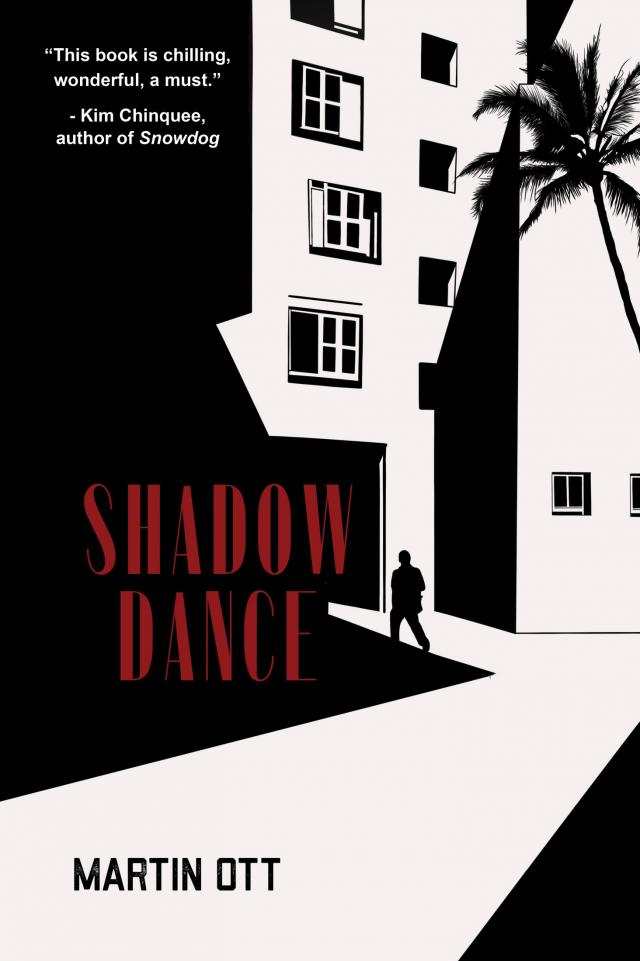
Contents
Praise for Shadow Dance
Shadow Dance
Copyright © 2023 Martin Ott. All rights reserved.
Dedication
Quote
Shadow in Limbo
Shadow in Motion
Shadow in the Rear View
Shadow Aim
Border Shadows
Sunset Shadows
Hell Shadows
Shadow Whisper
Shadow Cards
Shadow Projection
Shadow Nation
Shadow Boss
Drunken Shadows
Shadow Romance
Desert Shadows
Twin Shadows
Shadows from the Past
Shadows of the Silver Screen
Shadow Deception
Sunrise Shadows
Acknowledgments
Praise for Shadow Dance
“Martin Ott’s Shadow Dance is the perfect L.A. Noir novel for our times, with a little of everything—romance, drugs, filmmaking, PTSD, twisted families, repressed memories, and mysterious disappearances—all set in a sketchy strip club in Little Persia on L.A.’s West Side. Ott’s Buddy Rivet is a deeply flawed character, a hard-luck Army vet, who readers will root for, a soulful guy who wants to save the world but isn’t sure he can save himself. This book is L.A. Confidential meets The Family Fang, with all the deception and double-cross of a terrific crime story, told in breathless, blunt-force-trauma prose.”
– Clifford Garstang, author of Oliver’s Travels and The Shaman of Turtle Valley
“Shadow Dance is a powerful dance of language, a shadow of history, military trauma, and a unique coming-of-age tale of a man’s own past and attempt to move forward. Martin Ott has created yet another masterpiece full of suspense, beauty, and heart. This book is chilling, wonderful, a must.”
– Kim Chinquee, author of Snowdog
“Strange how the language of relationships can mimic that of war.” That’s Buddy, a/k/a West, leading this Shadow Dance like a spastic Astaire, and his musings go to the heart of Martin Ott’s imagining. A novel smeared by the torture in the Middle East, this Dance amounts finally to a twisted but miraculous cleansing, a rediscovery of love, by way of an eye-popping and wisecracking tour of the L.A. underworld. You’ve never had such fun at an exorcism. Martin Ott has created yet another masterpiece full of suspense, beauty, and heart. This book is chilling, wonderful, a must.”
- John Domini, author of The Color Inside a Melon
“With crisp, gimlet-eyed storytelling, Martin Ott’s Shadow Dance dramatizes compellingly the tough truth that, whether you’re enlisted in Afghanistan, home in Louisiana, or trying to do right in Los Angeles, war never ends.”
- Mark Wish, author of Watch Me Go, founding editor of Coolest American Stories
“‘Something bad’s going to happen,’ one Shadow Dance character remarks to West, a man who picked up his name on the run, heading west. The protagonist wonders how he knows. ‘Because something bad is always going to happen.’ And there you have it, the noir credo perfectly expressed, the central understanding in every dark thriller or hardboiled tale of the streets, and my oh my, does it express the tenor of our age. But among literature’s—and pulp fiction’s—empyrean of unforgettable tough guys, Martin Ott’s fascinating protagonist breaks the mold—a tormented, introspective empath and reader of Travis McGee detective stories tough guy.… Martin Ott’s prose weaves mood, velocity, grit and occasional concentrations of poetry. ‘Outside, the long day burned as though a distant fire was burning up the bowl of America.’ Shadow Dance joins the great tradition of novels that investigate dark corners within the light-filled city.”
- Suzanne Lummis, author of Open 24 Hours, Blue Lynx Poetry prize winner, host and creator of poetry.la’s They Write by Night, a YouTube series exploring the connection between poetry and film noir.
“Ott’s prose crackles and sizzles. There’s never a dull moment, right to the riveting end. It’s the kind of novel Hemingway might have written had he been alive today.”
- Erik Martiny, author of Night of the Long Goodbyes
Shadow Dance
Martin Ott
Regal House Publishing
Copyright © 2023 Martin Ott. All rights reserved.
Published by
Regal House Publishing, LLC
Raleigh, NC 27605
All rights reserved
ISBN -13 (paperback): 9781646033799
ISBN -13 (epub): 9781646033805
Library of Congress Control Number: 2022949229
All efforts were made to determine the copyright holders and obtain their permissions in any circumstance where copyrighted material was used. The publisher apologizes if any errors were made during this process, or if any omissions occurred. If noted, please contact the publisher and all efforts will be made to incorporate permissions in future editions.
Cover images and design by © C. B. Royal
Regal House Publishing, LLC
https://regalhousepublishing.com
The following is a work of fiction created by the author. All names, individuals, characters, places, items, brands, events, etc. were either the product of the author or were used fictitiously. Any name, place, event, person, brand, or item, current or past, is entirely coincidental.
All rights reserved. No part of this publication may be reproduced, stored in a retrieval system, or transmitted, in any form or by any means, electronic, mechanical, photocopying, recording, or otherwise, without the prior permission of Regal House Publishing.
Printed in the United States of America
Dedication
Dedicated to everyone I served with in the military
Quote
“Time flies over us but leaves its shadow behind.”
—Nathaniel Hawthorne
1
Shadow in Limbo
You’re not invisible. You may think you’ve snuck away, dropped off the grid, kept it all on the down-low. Don’t fool yourself, though. You’ve left a ripple of your presence wiggling in the intersection of darkness and light like a villain’s gloved fingers. Sometimes people squint at you as you dart along the periphery. Whether you try to do the wrong thing or the right thing, you ping along the moral axis of yesterdays and tomorrows. Up until now, I’d always counted myself with more rights than wrongs. And like everyone, I was followed by a shadow. Mine was barely the size of dog. At first, I thought it was Pops who spun tall tales with a fluency not unlike a second language. Later, I kidded myself that it was women looking to bed me, the ones I tried to ignore. But it was something else, a fleeting passenger that hounded me as a boy and haunted me as a man.
I joined the army the day I turned eighteen and ordered the shadow to stay home. Strangely, it listened for a time, losing itself in the sunset on the bayou, a dull fire shimmering in the eyes of everyone I left behind. There was no family to see me off (a story for another day) and my girlfriend Deirdre had told me I was a fucking idiot. Not that I blamed her for calling it like she saw it. Suffice to say that Private Buddy Rivet was looking to reinvent himself, and had to get himself sent to a damn war in the process. No one ever told me that I had a lick of sense. Especially not my best friend Solomon St. James, one of my fellow latchkey kids whose parents had jobs on the gambling riverboat Aces.
Unlike Deirdre, he didn’t think I was an asshat for not emailing while I was in Kabul. He knew I was intentionally difficult. Solomon mailed me letters from a string of small towns as he drifted from Lake Charles. He’d followed a progression of women westward, finding gigs as a DJ, enjoying his time on the road. I went the other direction. After spending so much time skirting the law in the company of my hoodlum parents and hoodlum friends, I needed order. I found it at a deserted Soviet base in Afghanistan—Bagram Airfield. My role there as military police was an impossible job. How do you help interrogators stop a war in a place where conflict is the same as the sun rising and falling? It made me hate…well…everyone.
The ghosts in my past were quieted by the ghosts from the airbase. I paced my rounds in the spaces between sunset and sunrise. I became scary in my own right, like the ferryman on the River Styx. But there were no coins passed to me, no price for passage into the darkness. Anyone I transported to and from the interrogation rooms was doomed and they knew it. We all looked away when the sun went down, blinded by our fears.
Now I was back in purgatory in a floating gas station in the middle of the Atlantic Ocean. This was probably not a fair assessment of Terceira Island, one of nine in the Azores, where the US kept an Air Force base called Lajes Field. For nearly sixty years soldiers passed through here to missions all over the world, some known, others hush-hush. As the troops in Afghanistan cycled out, the usage of Lajes Field was on the decline, at least until the US invested in another war. Our C-17 transport plane was undergoing minor repairs after a trip from Manas, which had passed through Iceland. Jet lag didn’t even begin to cover my feeling of being out of time and place.
We’d been set up with temporary shelter for the night in an open-room barracks. It was like a five-star hotel after becoming used to cots and rough living. Used to explosions and broken sleep. Used to having a rifle within arm’s reach the way a mother sleeps next to her baby. It would be my first mattress in more than a year. I couldn’t sleep, though. And neither could my squad of MPs. We tried playing cards i
We marched single file with me trailing in the rear. Staff Sergeant Lasicky was on point, and I made it a point to steer clear of him. The other MPs hated him as well, but he kept them all close in the way of a 1950s father, all commands and insults. Lasicky was a piece of work. In the space of a couple of hours, he made our squad feel guilty enough to go along for this unauthorized trip, while also making it clear that anyone getting out of line could be punished. This was next-level manipulation from a military police officer used to operating in the shadows. The guys were filled with bravado as the sun lowered on our shoulders, telling each other which woman was going to get the business when they got back to Louisiana.
“Rivet’s boyfriend is going to be jealous when he gets back after all the sweet loving he gave those prisoners.”
“Jackass,” I muttered under my breath every tenth step, counting to keep my cool, counting to keep myself from beating him within an inch of his life. The closer I came to landing in the states, something feral was stirred in me, perhaps the reason I’d avoided leave during my tours. A voice inside of me whispered to turn back, but the story of my life was never turning back. I didn’t want to be blinded by what might be there.
The countryside quickly gave way to a packed seaside town of white houses with tan roofs. We soon found ourselves on narrow streets with wave patterns on the sidewalks matching the designs on white gates dividing intersections. The sea calligraphy felt like runes, protection against primal forces. I wondered if this included the US military.
We ended up on Rua de Jesus and ducked into one of the cafés. The establishment had no name but featured an image above the door of a pig in a chef’s hat on its two hind legs holding a beer and winking toward the sidewalk. Plastic tables and chairs had been set out beneath temporary awnings flapping in the salty breeze wafting from the ocean. A few other servicemen from the base were already drinking there. The locals, meanwhile, congregated inside at long wooden tables. A division existed between the islanders and soldiers in this Azores crossroads situated somewhere between Portugal, the United States, and sleepy paradise.
During orientation, we’d been warned that we couldn’t wear uniforms outside Lajes Field. We were all dressed in army-issue brown T-shirts and jeans, still a gang even without the camouflage. I separated myself from the rest of the guys and sat at a small table pushed against one of the open glass doors. I was past worrying what the other MPs thought about me. I wouldn’t be pals with any of those fuckers after we returned to civilian life. I was the stickler for following rules, the tattletale for raising concerns to the company commander, the weirdo who liked spending time by myself. My closest friends had been the prisoners and, of course, my books, all of which had been left behind.
Now the only reading material I had was the most recent letter from Solomon. I’d looked at it enough on my final days that the folds were starting to fray. Not unlike our equipment. Our clothing. Our sense of humor. The other ex-prison guards started chugging beer at a table near the entrance, loud and getting louder. I tried not to listen to them from my table straddling worlds. Solomon’s cursive was still childish, with lavish hooks and swoops. Yet there was a section of the letter I kept coming back to, a sign that everything wasn’t okay: I’m banging this married chick and she’s messing with my mind. Her husband is my boss’s brother and I’m in way too deep with this family. They’re into some strange-ass shit. I can’t quit her or my job here at Club Paradise. I’m thinking about bolting but the set-up’s sweet. Too bad you aren’t here to set me straight.
Yes, I’d always been there for him. Even on the evening he decided to make a visit to our math teacher Mrs. Jenkins. The guys my age called her Mrs. Jerkins for how many of them incorporated her into their whack-off fantasies. Solomon, as usual, had a straightforward plan to hook up with her. He knew that her husband was drinking at Catfish Bar watching Monday Night Football and he decided to see if there was anything behind her in-class flirtations. After the sun fell, we pedaled our bikes over to her house in a subdivision adjacent to the school. I stood watch while he went inside with a thin cover story of needing help with his math homework. Once he was in the door, he figured things would take care of themselves.
Solomon had an impressive record with girls our own age. I still found it surprising, though, when our sexy math teacher invited him inside and closed the door behind him. I was supposed to signal him if someone came a knockin’ with a referee’s whistle we’d stolen from her husband, our gym teacher Bad-eye Jenkins. The dude’s nickname came from a glass eye he liked to pluck from his right socket and point at you when he was pissed. Which was most of the time. No one knew what had caused the injury. Some say it was a hunting accident. Others a high school football injury. Still others believed he pulled it out himself after the Saints lost one too many games on the final drive. Regardless, it made the hulk of a man in a tracksuit seem more monster than human.
What came next was partially my fault. I was spacing out behind a tree and didn’t notice the pickup truck barreling down the two-lane road with a single headlight—like truck like owner. I clinched the whistle in my lips and froze. Bad-eye had the window down and would hear that something was up, would be in the driveway in moments. I launched myself, pedaling furiously onto the shoulder of the road, catching the truck turning into the driveway.
Too fast, I remember myself thinking before I got clipped and the world grew fuzzy. That night I got my first concussion, several dislocated fingers, and road rash from sliding across the hood and onto the asphalt. My arms kept me from breaking my neck, I suppose. The ambulance ride was kind of cool, even though my folks had to move to dodge paying the bill. Most importantly, Solomon had a chance to get away from the scene. In the emergency room and for weeks after, I felt like a badass.
I stared at the last two fingers of my left hand, still curved from the dislocation, clutching Solomon’s letter. I’d always found comfort and meaning in scars the way others looked at tattoos. Each of them defined me in some way.
“Walk away, witch!” Lasicky belted out from across the courtyard.
Some weird shit was going down. A thin woman in white shorts, a black sweater, and purple headscarf backed away from the table of MPs, speaking softly but quickly as though throwing a curse. She wasn’t moving quickly enough for Lasicky. He tossed a half glass of beer at her face and she raced for my table. I grabbed her hand in passing and stood up, wiping her dripping face with the tail of my shirt.
I glanced over at the bar but the waiters weren’t coming outside. Lasicky challenged me with a stare. He wanted me to throw down. “Waste of a good beer,” he muttered. The woman looked at me as though I was a scientific curiosity, her scowl transforming into a smile. My free hand unclenched from a fist and she held that one as well.
“I’m sorry about my friends,” I said.
“Are they really your friends?” she asked in Portuguese accent.
“No, guess not.”
“Then don’t apologize.”
“Maybe Rivet isn’t a fag after all,” Lasicky called out. “Maybe he just likes old hags.”
I turned sideways so I wouldn’t see his smug grin. “Why did that idiot get mad at you?” I asked.
“I read his palm and told him the truth. That he was going to be seriously injured. And soon. He told me he didn’t survive a war only to have some bitch put a hex on him.”
The boys from my unit were all Louisiana born and bred, with a healthy dislike for anything that smacked of black magic.