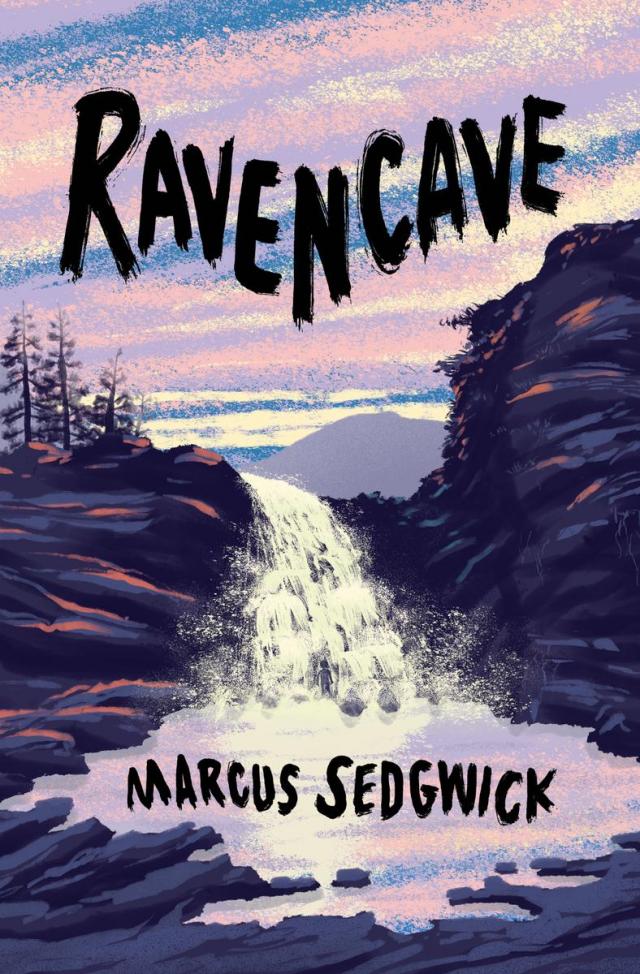
Ravencave, p.1
Ravencave, page 1


Praise for Wrath by Marcus Sedgwick
“Thought-provoking and atmospheric” THE BOOKSELLER
“A brilliantly unsettling novel that readers will race through” SARAH CROSSAN
“Meaningful, powerful, wonderful” TOM PALMER
“Such a delicately wrought and cleverly done piece of climate fiction, told through the lens of teenagers’ lives. Really beautiful” LAUREN JAMES
“So, so good. A treasure. Exactly as brilliant as I thought it would be” DAN SMITH
“A thrilling, thought-provoking, timely novella … Wrath presents a poignantly original way of thinking about climate change and how we relate to each other” LOVEREADING4SCHOOLS
“Fast paced and engaging” INIS
“A multi-layered story with lots to engage teenage readers ... A powerful and thought-provoking mystery drama from a skilful storyteller, with a satisfying and hopeful ending too” BOOKS FOR KEEPS
“A fascinating and layered drama for all of Sedgwick’s many fans” THE BOOKBAG
“Sedgwick is such a skilful writer and tells such a compelling story that it’s hard to imagine that anyone picking this up could put it down until it’s finished … A real treat” THE LETTERPRESS PROJECT
“A layered, unsettling and intelligent novella that I’ll be thinking about for a while” ANNE THOMPSON, “A LIBRARY LADY”
“What a wondrous little book; as bleak, yet beautiful and hopeful as the turning point in our planet’s history at which we now find ourselves” JAMES HADDELL
“Literally no word is wasted … I was completely enthralled” PRIMARY TEACHER BOOKSHELF
“A brilliant novella. Read in one sitting. Timely, intense, full of suspense” JO BOWERS
For our ancestors
CONTENTS
TITLE PAGE
DEDICATION
ONE
TWO
THREE
FOUR
FIVE
SIX
SEVEN
EIGHT
NINE
TEN
ELEVEN
TWELVE
THIRTEEN
FOURTEEN
FIFTEEN
SIXTEEN
COPYRIGHT
ONE
“This place is full of ghosts,” says Mum. “This entire landscape.”
No one answers her. They’re walking ahead of me anyway – Mum, Dad, Robbie. I only hear Mum’s voice because the wind picks it up and brings it down the path to me. I’ve stopped by the ruin – the ruin of Crackpot Hall.
The abandoned, derelict buildings stand over the wide valley below, but I don’t see any ghosts. I don’t see anyone at all – not a thing moving, not a person, not even a bird in the sky.
I’ve stopped because I can’t go on. This often happens – my family have left me behind. They forget I can’t keep up. Robbie is two years older than me, nearly three, in fact. And Mum and Dad are the types who march over mountains without a moment’s thought.
They move on. I watch them go, leaving me further behind. I know we have to hurry. Dad explained that when we set out this morning.
“There’s bad weather coming in later,” he said. “I know it looks nice now, but we have to be back before mid-afternoon.”
“We’ll be fine,” Mum replied, and Robbie said nothing. And then we set out later than we meant to. Which means no one is waiting for me. And I know we have to hurry. I know we do, because we came here to do this important thing for Dad. For his mum.
We leave tomorrow, after our week’s holiday, and the weather hasn’t been great. There hasn’t been the chance to get up here. We’ve just been stuck in our rooms in the pub or visiting places. Mum and Dad have been getting cross with each other. It’s rained a lot – not like last year, when it was sunny the whole time. That was the first time we came here, a year ago, around Easter too.
*
On that last visit, it was really hot, like summer. And one day we did the same walk as today, up past Crackpot Hall and beyond.
Exactly the same thing happened then. I remember stopping on this very same spot on this very same bend in the footpath. After this, the bend climbs up to the Hall and then snakes around the back of it, before running on, flatter again, to the east.
I stood here then, almost exactly a year ago, out of breath, while the others had gone ahead of me. I remember looking at the view of the valley, basking in hot spring sunshine. It felt too hot for the time of year. This seemed to be a place that was normally wet and grey and windy. But that day it was really hot. I wanted to go and swim in the waterfalls to cool off, but Mum and Dad wanted to walk, so that was what we did.
I stood and panted and looked down the valley, and I tried to connect with it. I tried to feel something for it. I tried to feel anything, just to please Dad, because that was mostly why we were here, that time a year ago. It was why we’d chosen the Yorkshire Dales for our holiday, so that Dad could poke around the villages where his grandparents and great-grandparents had lived. It had become so important to him, for some reason. He seemed to be upset that I felt nothing for the place, and neither did Mum or Robbie.
Dad would look at Robbie and me and say, “My grandfather was born here,” or, “My great-grandmother was born there.” We’d stand looking blankly at Dad, and he’d say, “They’re your ancestors too, you know!” And still we’d look blankly at him, and he’d go quiet for hours.
Dad never used to be interested in his family history. Mum said it was his age – suddenly he wanted a sense of where he came from, or something.
Maybe she was right – that if Dad knows where he came from, he will know who he is. Whatever the reason, he’s been obsessed with his family history now for a couple of years.
I also remember, a year ago, how I stopped just short of the Hall. Robbie came bounding back down the path to get me, full of excitement.
“You have to see this place!” Robbie said. “You won’t guess what it’s called.”
So I made myself move again and followed Robbie into the ruin, panting in the heat.
The name Crackpot Hall makes it sound like it’s some huge stately home, but it isn’t that kind of place. It’s a farmhouse, that’s all. Or it was. It must have been one or maybe two large buildings with some outbuildings attached. But the roofs have all gone now, fallen in.
It’s still a great place to play in, but Mum shouted at Robbie and me as we started climbing over walls, saying it wasn’t safe. She said one day one of us would have a proper accident and then we’d learn to be more careful. Mum was probably right, but we ignored her for a bit until she got really cross, and then she went to go and look at the view.
Dad smiled at Robbie and me.
“Some spot, eh?” Dad said.
He stood looking down the valley. He’d forgotten the open guidebook in his hand. The landscape was … I don’t know how to describe it. Wide, open, green. Beautiful.
Sad too, somehow. I don’t know why I thought that – I just felt it.
“They might have only been farmers who lived here,” Dad added, “but they had a view fit for a king.”
“Why do kings get the best of everything?” asked Robbie. But before anyone could answer, he ran off. Never stays still for long, does Robbie.
Dad stuck his nose back in the guidebook.
“Ha,” he said. “Crackpot doesn’t mean what you think it means.”
“What do I think it means?” I asked.
“You think it means like a crazy person. A lunatic, right?”
“Maybe,” I said, because that’s exactly what I had been thinking.
Mum was coming back and heard.
“Crackpot means ‘cave of the ravens’,” she said.
Dad scowled at her, but in a funny way.
“How did you know that?” Dad asked.
“Read about it over breakfast,” Mum said. She looked at me and explained, “Crackpot comes from old words. Norse words. The language that the Vikings spoke. Crack comes from their word for raven, kraka, and pot meant a cave or a hole. Actually, we still use that word. As in ‘potholing’ – when people go caving. So its real name is Ravencave.”
“But I don’t see any caves marked on the map,” said Dad. “That’s strange.”
Mum shivered.
“Why anyone would want to crawl around in holes deep underground is beyond me,” she said. “Some people do weird things for pleasure, don’t they? Why go underground when you could be looking at all this beauty?”
She waved an arm at the view, but I wasn’t seeing what Mum was seeing.
“There were Vikings here?” I asked. It was hard to believe anyone had ever been here, aside from walkers like us. Only the ruins of the farm showed that at some point people had lived here, high up, but I couldn’t imagine what they’d been doing.
“Vikings?” Dad said. “Yes, they were here. A thousand years ago last Wednesday. “Give or take.”
He chuckled and we set off again, leaving Crackpot Hall behind us.
*
That was all a year ago. And some things are the same and some things have changed.
Robbie is Robbie, but he is a new version of Robbie, one who doesn’t seem to like me any more.
Meanwhile, I have a large scar on my knee from where I fell a year ago. I’d been trying to keep up with him, clambering over the rocks at the river fairly near here.
Mum was a writer, but she wasn’t writing anything back then and she isn’t now. In fact, I only have a vague memory of when she did write. Are you still a writer if you no long er write anything?
Dad tells Mum she still is a writer. He tells her all the time. It doesn’t seem to help. In fact, it seems to make things worse. Mum was pretty successful once.
And then there’s Dad. Things have changed for him because he lost his job – just a week before we came away. No one knows what’s going to happen now. Mum’s been working part-time at the local arts centre for about a year, but without Dad’s income, things aren’t looking good …
I was amazed we still came on holiday this year, but Dad said, “It’s all paid for already. We’re going. And when we get back, I’ll figure out what to do.”
So we came, and here we are, four souls spread across the Yorkshire landscape. I am left wondering how it is that people go on. How do people keep on going, even when everything seems to be against them?
I watch Mum and Dad, twenty metres apart, higher up on the trail. Robbie is nowhere to be seen. He’s already out of sight ahead of them, over the crest of the hill.
What makes people go on? I think.
Then I think, I am too young to be thinking thoughts like this, aren’t I?
Then I decide that thought is weird in itself. I realise what’s more important: I had better try to catch up before they lose me entirely.
I skirt around and above the back of the ruin of the place that should be called Ravencave Hall. As I walk, I realise that I do know what makes Mum go on.
She’s chasing ghosts.
People say that sometimes. They say, “Oh, so-and-so, he’s chasing a ghost.” It means they’re doing something hopeless, looking for something that they will never find. But with Mum, it’s different. She really is looking for ghosts, and this is not some silly pipe dream, because she has chased them before. And found them. Often.
TWO
Let me tell you this story, if you don’t believe my mum can see ghosts, or if you don’t believe in ghosts at all. I promise you it’s true. I wasn’t born at the time, nor Robbie. It happened when Mum and Dad were young – before they were married in fact.
They’d been seeing each other for a few months, and the time came for Mum to meet Dad’s mum, my granny. Granny is the reason we’ve come back to the Yorkshire Dales this year. It’s her ashes that we’re going to spread, high up in Swaledale.
It’s been a pretty difficult time recently. Granny died just a few weeks before Dad lost his job. In Granny’s will, she said she wanted to go home. That meant, Dad explained, that she wanted her ashes spread where she was born, more or less. And that meant Swaledale. But that’s not the story I’m telling now.
Granny moved to the South when she was just a kid, and married Dad’s dad. They lived almost all their lives in an old cottage in Sussex. Granny stayed there after she became a widow. Not long after they started going out, Dad took Mum down there to stay one weekend.
Mum and Granny got on well right from the start. That evening, they all had tea in the old, low-beamed dining room. Later, Mum and Dad went to bed and were alone in their room, and Mum said, “Who was the old man in a black suit, sitting by the fireplace?”
Of course, there had been no one there, not a real person, not someone that anyone else could see. Only Mum saw the man in the black suit. She told Dad he should know this thing about her – that sometimes Mum sees stuff. Ghosts and “other things”.
I used to ask her what she meant by “other things”. But she said I was too young to be told, and she would always change the subject. I guessed that what she saw were dark things. Scary things. Somehow it’s worse not knowing exactly.
Anyway, Dad didn’t believe Mum. He just went along with it. He didn’t say she was lying, but he didn’t actually believe her. And Dad didn’t mention it to Granny, because he didn’t want to scare her, or fill her head with ideas about ghosts when she lived all alone and was already starting to get old.
But a few years later, something happened that changed Dad’s mind. By this time, he and Mum had got married. Robbie was a toddler and I was a baby. Granny had a problem with her house. There was water running into the sitting room, through the back wall. The house is on a slight slope, and it seemed that some old spring had opened up in the hillside, and water was coming into the house.
It was really upsetting for Granny. She had to fight with the insurance people. Dad says you pay insurers to do just one thing, but when it’s finally time for them to do what they promised, they do everything that they can to get out of paying up.
And there were workers crawling all over the place – drainage specialists, engineers – trying to figure out where the water was coming in and how to fix it. But no one could, so Granny was very worried.
Dad left Mum at home with me and Robbie, and went to see if he could help. I mean, there was nothing he could do about the water problem, but he could at least be there to support Granny. So Dad went and stayed for the weekend, and that Saturday afternoon, Granny took a phone call.
Even though it was a Saturday, two workers were still poking around in the garden using special radar that can see into the ground, trying to find the route the water was taking into the house.
“Yes,” Granny said into the phone, with Dad watching. “Yes, if you can. Mrs Bromley told me about you. Yes. Today? Yes, if you can. Oh, thank you.”
She hung up and turned to Dad, smiling.
“Well, I know you’ll say it’s silly, dear,” Granny said, “but I heard about this lady from Jean Bromley. She’s a water diviner. A dowser. She can find water, where it’s hiding … She’s going to come over.”
At three o’clock, the woman arrived. Dad said he didn’t know what he’d been expecting really – maybe some old lady with a red handkerchief wrapped around her head and too much silver jewellery. But the woman was very ordinary looking. Dad said she was dressed as if she was an estate agent or something.
Anyway, the lady walked around the garden for five minutes, smiling at the workers. Then she came back over and said to Granny, “They’re looking in the wrong place – there’s a stream underground that runs along the side of the garden, and then, under the terrace, there’s a small reservoir. It’s blocked, and the stream is backing up and is coming through your sitting-room wall instead.”
The lady walked over to the terrace and stamped with her foot where she said the hidden reservoir was. The workers came over with their radar, shaking their heads and smirking until they got their equipment running. Then they stopped smirking because everything the water diviner had said turned out to be true. She had solved in a moment the problem a dozen experts had not been able to solve in months.
Granny smiled. “Oh, thank you so much,” she said in that simple way of hers. ‘I’m so relieved. Now, you’ve come a long way, would you like a cup of tea?”
So they went inside and sat in the old, low-beamed dining room, chatting about this and that. Then the woman looked first at Dad and then at Granny and said, “Now, I don’t want to alarm you, but tell me, who is the old man in a black suit sitting by the fireplace?”
Dad just stared. He said he went cold all over and just stared.
Granny got all excited at the idea she had a ghost living with her and wasn’t scared one bit. She said the cottage was very old and she didn’t really know who had lived in it before her. It certainly wasn’t Dad’s dad, her husband, because he had never worn a suit in his life.
Dad just stared at the fireplace, and when he got home, he told Mum what had happened and how the water diviner had seen exactly the same person Mum had, five years earlier. Dad said he was sorry, and then he went quiet, because he was remembering all the “other things” Mum had said she’d seen, things he hadn’t believed. This included things Dad didn’t want to believe, things they still have never told me. Mum and Dad say that Robbie and I are too young to hear certain stories.
So Dad changed his mind about Mum being able to see ghosts – or rather, he had his mind changed for him. He says, in his defence, he had never had any experience with ghosts, so it wasn’t his fault he didn’t believe in them. But Mum says it just shows you should never think you know everything and that other people might know things you don’t.
But Dad’s still not happy about Mum seeing ghosts. I think it’s cool, and Robbie doesn’t seem to care either way, but Dad … there’s something about it that bothers him. It bothers him a lot. I don’t think it’s that he’s scared – it’s something else.