

Freedom, p.1
Freedom, page 1


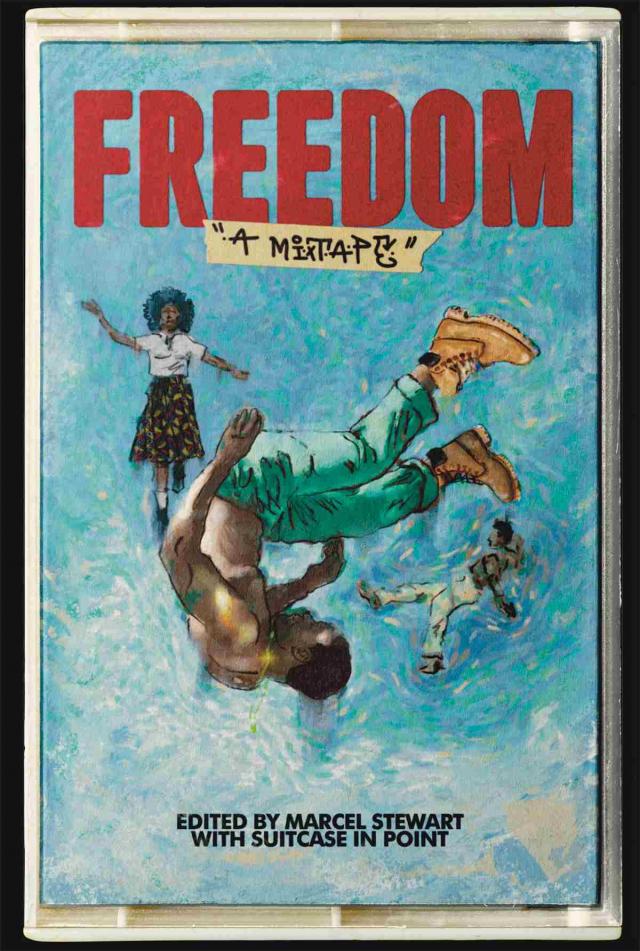
Freedom: A Mixtape
Edited By Marcel Stewart
with Suitcase in Point
Playwrights Canada Press
Toronto
Freedom: A Mixtape © Copyright 2024 by Marcel Stewart
Illustrations © Copyright 2024 by Chance Mutuku, BBBBLANC* Studio®
First edition: January 2024
Printed and bound in Canada by Imprimerie Gauvin, Gatineau
Jacket art and design by Chance Mutuku, BBBBLANC* Studio®
Playwrights Canada Press
202-269 Richmond St. W., Toronto, ON M5V 1X1
416.703.0013 | info@playwrightscanada.com | www.playwrightscanada.com
No part of this book may be reproduced, downloaded, or used in any form or by any means without the prior written permission of the publisher, except for excerpts in a review or by a license from Access Copyright, www.accesscopyright.ca.
For professional or amateur production rights, please contact Playwrights Canada Press.
Library and Archives Canada Cataloguing in Publication
Title: Freedom : a mixtape / edited by Marcel Stewart ; with Suitcase in Point.
Names: Stewart, Marcel, editor. | Suitcase in Point (Arts organization), contributor.
Description: First edition. | A collection of original songs, stories, poems, anecdotes,
spoken-word pieces, and musical instrumentation performed as a dramatic whole.
Identifiers: Canadiana (print) 20230596258 | Canadiana (ebook) 20230596266
| ISBN 9780369104779 (softcover) | ISBN 9780369104786 (PDF)
| ISBN 9780369104793 (EPUB)
Subjects: LCGFT: Experimental drama. | LCGFT: Drama.
Classification: LCC PS8600 .F74 2024 | DDC C812/.6—dc23
Playwrights Canada Press staff work across Turtle Island, on Treaty 7, Treaty 13, and Treaty 20 territories, which are the current and ancestral homes of the Anishinaabe Nations (Ojibwe / Chippewa, Odawa, Potawatomi, Algonquin, Saulteaux, Nipissing, and Mississauga / Michi Saagiig), the Blackfoot Confederacy (Kainai, Piikani, and Siksika), néhiyaw, Sioux, Stoney Nakoda, Tsuut’ina, Wendat, and members of the Haudenosaunee Confederacy (Mohawk, Oneida, Onondaga, Cayuga, Seneca, and Tuscarora), as well as Metis and Inuit peoples. It always was and always will be Indigenous land.
We acknowledge the financial support of the Canada Council for the Arts, the Ontario Arts Council (OAC), Ontario Creates, the Government of Ontario, and the Government of Canada for our publishing activities.
This book is dedicated to those whose tomorrows were taken away . . .
Trayvon Martin, Jordan Davis, Michael Eligon, Eric Garner, Junior Manon, Michael Brown, Tamir Rice, Walter Scott, Freddie Gray, Albert Johnson, Jamar Clark, Eric Osawe, Bettie Jones, Sandra Bland, Samuel Dubose, Nathaniel Harris Pickett Jr., Richard Perkins Jr., Andrew Loku, Clementa C. Pinckney, Cynthia Marie Graham Hurd, Susie Jackson, Ethel Lee Lance, DePayne Middleton-Doctor, Tywanza Sanders, Daniel L. Simmons Sr., Sharonda Coleman-Singleton, Myra Thompson, Neil Stonechild, Kaleb Alexander, Marc Boekwa Diza Ekamba, Raymond Lawrence, Darrius Stewart, Alex Wettlaufer, Philando Castile, Alton Sterling, Terence Crutcher, Deravis Caine Rogers, Jessica Nelson-Williams, Cynthia Fields, Abdirahman Abdi, Botham Jean, Olando Brown, Josephine Pelletier, Stephon Clark, Clive Mensah, Ahmaud Arbery, Eishia Hudson, Nina Pop, Breonna Taylor, George Floyd, Tony McDade, Regis Korchinski-Paquet, Rodney Levi, Chantel Moore, Ejaz Ahmed Choudry, Abraham Natanine, Stewart Kevin Andrews, Julian Jones, and so many more.
Tracklist
Foreword by Dian Marie Bridge
Production History
Epigraphs
Intro
Land Acknowledgement
Cypher
Sundown, Composed by Phil Davis, Sung by Phil Davis and Penny J. Bowers
One
Emancipate Yourselves
Kattawe Henry Pt. 1
Barry Stewart Pt. 1
Two
The Limitless Potential of Sugar Cane Plantations
Barry Stewart Pt. 2
Diana Myrie
Vicki-Lynn Smith
The Tides by Tethered The Ghost
Three
Step to the Mic / Arrival for Wha?
Emancipation by Haui
Emancipation by Roselyn Kelada-Sedra
Four
Shoot to Kill
Free / For You & Me, Music and Lyrics by Iain Ellis Lidstone
Barry Stewart Pt. 3
Freedom (The Right to Anything?) by Eve Atoms
Kattawe Henry Pt. 2
Five
Resistance Resistance Resistance
Freedom by Jermaine Marshall
Fly High by Samuel Nkomo / Yung Dashiki
Six
From a Question to an Answer
Afterword: Freedom In St. Catharines by Deanna Jones
Recommended Reading
Acknowledgements
About the Editors
Notes on Contributors
Foreword
Dian Marie Bridge
In the early months of 2020, at the start of “The Great Reshuffling” that producing theatre became, during the COVID-19 pandemic and a new wave of civic-minded conscious awakenings, it seemed that the world stepped into an acute awareness of the need for connection, community, and overall fairness. The ways in which we understood and saw ourselves and each other were shifting in real-time, and we were accountable to community in a way that many had not experienced before, and collectively had not seen since the early 1900s. How we cared for ourselves and those around us now had an impact on everyone. Now we could rethink history, community, and plans for our collective future with the shifted perspective offered by this view. The world recalibrated, and the need for the arts made itself evident.
In the theatre community, the need to connect audience and artist crystallized, as many projects shifted online, and theatre makers became digital content producers. It was around this time that Marcel Stewart approached me to work as the dramaturg on a new community-based project he was leading with Suitcase in Point Theatre.
Marcel and I had both graduated from Brock University’s theatre program, albeit many years apart, so the arts community in St. Catharines, Ontario, was one that we had both been a part of at some point. We spoke about the idea of artmaking and storytelling being a kind of archiving, that each one of us was simply at different points on the same path, and the responsibility to participate in that storytelling as we move into eldership, while honouring those who came before.
It’s been an absolute privilege to work with Marcel on this project and to experience this very personal brand of storytelling that is also incredibly charming and full of nostalgia. The invitation to the larger Niagara community and their interpretation of what it means to share in art was an absolute joy as well.
Story is the thread that binds community and any work we make is indeed in the larger continuum of work. Freedom: A Mixtape is a celebratory and joy-filled tribute to and by the Niagara region’s Black arts community’s resiliency, creativity, and deep love.
Dian Marie Bridge
Theatre Maker
Artistic Director, Black Theatre Workshop
Freedom: A Community Mixtape was first launched by Suitcase in Point, St. Catharines, on August 7, 2020, with the following contributors:
Phil Davis
Penny J. Bowers
Kattawe Henry
Barry Stewart
Diana Myrie
Vicki-Lynn Smith
Tethered The Ghost
Haui
Alex Ring
Roselyn Kelada-Sedra
Iain Ellis Lidstone
Eve Atoms
Jermaine Marshall
Yung Dashiki
Executive Producer: Marcel Stewart
Producers: Deanna Jones, Tamara Jensen, and Holly Keus
Sound Design: Andrew Johnson
Album Artwork: Chance Mutuku
Dramaturg and Narrative Consultant: Dian Marie Bridge
Freedom: Live was presented by Suitcase in Point as part of Rhizomes 2020, from September 24 to 27, 2020, with the following cast and creative team:
Eve Atoms
Iain Ellis Lidstone
Alex Ring
Roselyn Kelada-Sedra
Marcel Stewart
Director: Deanna Jones
Associate Director: Marcel Stewart
Producers: Tamara Jensen and Holly Keus
Creative Scenic Design: Chance Mutuku
Special thanks to Natasha Pedros, Stephen Remus, Matt Caldwell, Cree Tylee, and all of the other folks at Niagara Artists Centre who supported the development of this production.
I am made of love.
—La Marr Jurelle Bruce, How to Go Mad without Losing Your Mind I feel most indigenous when I am surrounded by Black folks from various parts of the diaspora. In this beautiful space, we engage in conversations about our parents’ sayings, habits, and dreams. We are arguing about who makes the best food, though we cannot deny that they’re just slightly different ways of preparing the sa
—Erika R. Hardaway, from Black Powerful, curated by Natasha Marin Rotating bodies, confusion of sound
Negative imagery, holding us down
Social delusion, clearly constructed
Human condition, morals corrupted
—Lauryn Hill, “Motives and Thoughts” Freedom over everything, I solemnly swear
I will offer no apology for sorrow or tears
Every time I look to the stars, tomorrow appears
And everybody who believes in me can follow me there
—Black Thought, “Freedom over Everything” from Freedom Over Everything by Vince Mendoza and the Czech National Symphony Orchestra The conditions of Black life, past and present, work against any notion that what we inhabit in the now is freedom. Postslavery and postcolony, Black people, globally, have yet to experience freedom. We remain in the time of emancipation. Emancipation is commonly understood as the “freeing of the slaves” in the post-Columbus world, but emancipation is a legal process and term that I will argue marks continued unfreedom, not the freedom it supposedly ushered in.
—Rinaldo Walcott, The Long Emancipation
Intro
I put my lifetime in between the paper’s lines
—Prodigy, Mobb Deep, “Quiet Storm”
Land Acknowledgement
the performers acknowledge the nations on whose territories they are performing
Cypher
the following can be performed a cappella or with a variety of musical accompaniment. a beatboxed underscore would be pretty dope.
Oh, freedom. Oh, freedom. Oh, freedom over me.
And before I be a slave,
I’ll be buried in my grave,
And go home to my lord and be free.1
abrupt static noise.
Call: No justice.
Response: No peace.
Call: No justice.
Response: No peace.
Call: No justice.
Response: No peace.
Call: No racist.
Response: Police.
abrupt static noise.
We are the nation, the next generation.
abrupt static noise.
We need justice.
We need justice.
We need justice.
We need justice.
We need justice.
We need justice.
* * *
1 “Oh Freedom!” performed by the Golden Gospel Singers, released in 1997 on A Cappella Praise. The song itself has its roots in the post–Civil War spiritual “Before I’d Be a Slave.”
Sundown
Composed by Phil Davis
Sung by Phil Davis and Penny J. Bowers
“Sundown” was sung in the Pow Wow style of singing, and these songs are composed to express emotion by using the voice as the instrument. There is no language being spoken here except the language felt by the heart. Vocables are a freedom of expression, allowing songs to be shared nation to nation among Indigenous Peoples without having to translate language, enabling everyone who sings or listens to simply feel the emotion being shared. Typically, this would have been sung on a big drum with a number of male singers gathered around the drum and any females standing behind them singing backup. The Cree-style hand drum was chosen for the intimate setting of this recording.
This song in particular has been used to honour peoples, present and past, and more importantly as a memorial song to convey respect and acknowledgment toward individuals who have journeyed from life as we know it—a freedom each of us will bear one day, a Sundown. Memorial songs like this one are sung to support those whose hearts are heavy with grief, to offer freedom from sorrow, to help alleviate the weight of sadness, to lighten and free one’s spirit from carrying such heaviness in their hearts.
One
This is my story, wait, nah
This is our story, this is our fate
This is our kingdom, this is our place
This is our freedom, cut off them chains
This is our struggle, this is our pain
This is our love, this is our trust
This is our daughters, this is our sons
Give me back my wings, yeah oh
Give me back my wings, see
—Little Simz, “Wings”
Emancipate Yourselves
There’s so much I want to say,
This is my story . . .
Hello . . .
Can you hear me? . . .
Can you see me? . . .
Look at me . . .
There’s so much ground I want to cover,
1791 . . . 2
1793 . . . 3
1804 . . . 4
1888 . . . 5
1915 . . .
1948 . . . 6
1985 . . .
1990 . . .
So many forgotten stories. So many lost names,
Clive Mensah
Olando Brown
Junior Manon
Eric Osawe
Raymond Lawrence
Albert Johnson
Chloe Cooley
There’s a voice in my head, wrestling to keep my mouth quiet,
You don’t know what you’re talking about!
That’s wrong!
Don’t start there!
Nobody wants to hear from you!
Freedom, to me, is Bob Marley . . .
“Emancipate yourselves from mental slavery.” 7
I grew up on Bob. Sunday mornings, my dad cooking up ackee and saltfish and fried dumplings for breakfast, my mom undoing the braids in my sister’s hair, getting ready for a Wash Day. Peter Tosh, Bunny Wailer, Bob, and the rest of the crew blessing the house with all the chunes.
“Emancipate yourselves from mental slavery.”
Emancipate yourselves from mental slavery.
We must emancipate ourselves from mental slavery.
We must emancipate ourselves.
We.
Must.
Free.
Ourselves.
Freedom, to me, today, starts from within.
I’m Marcel
Bahksiiiiiide8
Yessuh
Yerrrrrrr
Tell em nuh!
Hahahahahahahahahaha
Come and take a walk with me.
* * *
2 The Constitutional Act of 1791 split the province of Quebec into two distinct colonies: Lower Canada in the east and Upper Canada in the west.
3 On July 9, the Act Against Slavery passed into law, making Upper Canada the first British territory to bring in legislation against slavery, although it does not abolish slavery entirely.
4 Haiti gains independence from France and becomes the first Black republic, having the only successful slave revolt ever.
5 The events of Jack the Ripper happen this year.
6 The year Gandhi is murdered.
7 “Redemption Song” by Bob Marley and the Wailers is released in 1980 on Uprising.
8 Jamaican term used mostly when you are surprised. It’s also one of my dad’s favourite sayings.
Kattawe Henry Pt. 1






