The war pianist, p.1
The War Pianist, page 1
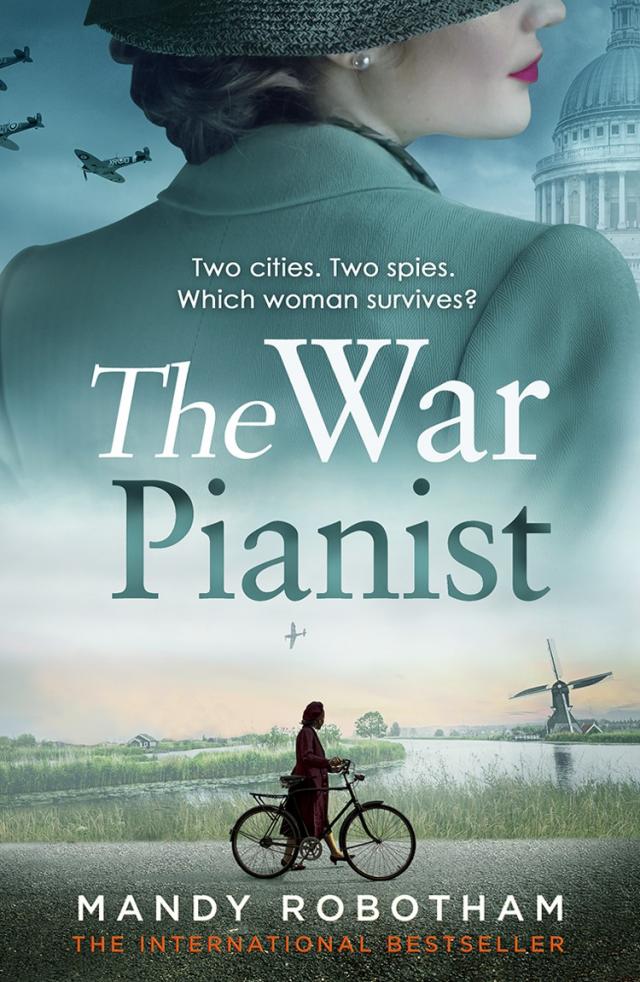


THE WAR PIANIST
Mandy Robotham
Copyright
Published by AVON
A Division of HarperCollinsPublishers Ltd
1 London Bridge Street
London SE1 9GF
www.harpercollins.co.uk
First published in Great Britain by HarperCollinsPublishers 2023
Copyright © Mandy Robotham 2023
Cover design by Stephen Mulcahey © HarperCollinsPublishers Ltd 2023
Cover photographs: © Ildiko Neer/Trevillion Images (woman),
© Stephen Mulcahey /Arcangel Images (woman with bicycle) and Depositphotos Shutterstock.com (all other images)
Mandy Robotham asserts the moral right to be identified as the author of this work.
A catalogue copy of this book is available from the British Library.
This novel is entirely a work of fiction. The names, characters and incidents portrayed in it are the work of the author’s imagination. Any resemblance to actual persons, living or dead, events or localities is entirely coincidental.
All rights reserved under International and Pan-American Copyright Conventions. By payment of the required fees, you have been granted the non-exclusive, non-transferable right to access and read the text of this ebook on screen. No part of this text may be reproduced, transmitted, downloaded, decompiled, reverse engineered, or stored in or introduced into any information storage and retrieval system, in any form or by any means, whether electronic or mechanical, now known or hereinafter invented, without the express written permission of HarperCollins.
Source ISBN: 9780008453442
Ebook Edition © February 2023 ISBN: 9780008453459
Version: 2023-01-16
Dedication
To the feisty female crew of Stroud Maternity Unit – today’s warriors waging a different kind of war.
Contents
Cover
Title Page
Copyright
Dedication
Author’s note
Prologue: Up and Away
Part One
Chapter 1. Following the Flow
Chapter 2. The Glittering City
Chapter 3. Into the Void
Chapter 4. Hidden Treasure
Chapter 5. The Conduit
Chapter 6. The ARP Man
Chapter 7. Live for the Living
Chapter 8. The People’s Zoo
Chapter 9. The Pendulum
Chapter 10. Radio Days
Chapter 11. A Message from Will
Chapter 12. Assaulted
Chapter 13. A Vital Cog
Chapter 14. New Resistance
Chapter 15. Regards to Darcy
Chapter 16. The Bank Manager
Chapter 17. Missing
Chapter 18. A Raging Storm
Chapter 19. A Suit of Armour
Chapter 20. A Shadow in the Basement
Chapter 21. Spies Like Us
Chapter 22. News
Chapter 23. My Good Friend Gus
Chapter 24. The Burrowing Beast
Chapter 25. The Palace of Light and Dark
Chapter 26. Choose Cheese for Christmas
Chapter 27. Darling Girl
Chapter 28. Back in the Basement
Chapter 29. Friends or Enemies?
Chapter 30. Pushing On
Chapter 31. Caught
Chapter 32. The House of Custody
Part Two
Chapter 33. Taking the Leap
Chapter 34. Welcome to Holland
Chapter 35. In the Stewing Pot
Chapter 36. The End
Chapter 37. Amsterdam at Last
Chapter 38. The Volcano
Chapter 39. Proving Useful
Chapter 40. Mending the Fabric
Chapter 41. Bluffing
Chapter 42. Home Truths
Chapter 43. The Plan
Chapter 44. The Enduring Wait
Chapter 45. The Break-Out
Chapter 46. Noah’s Ark
Chapter 47. Eruption
Chapter 48. A New Look
Chapter 49. Melting Ice
Chapter 50. The Palette of Imprisonment
Chapter 51. Calm Before the Storm
Chapter 52. Captive
Chapter 53. Moving
Chapter 54. Gladiators
Chapter 55. Daisy and Lizzy
Chapter 56. A Mother’s Intuition
Chapter 57. The Burrowing Beast Surfaces
Chapter 58. I See Everything
Chapter 59. Flight
Chapter 60. The Guillotine
Chapter 61. Over the Abyss
Acknowledgements
Keep Reading …
About the Author
By the same author
About the Publisher
Author’s note
Having travelled physically and metaphorically across Europe in previous books, I realised it was high time I ‘came home’ with a story of Britain’s struggles in the 1940s. Why so long? I ask myself. Is it because life on different shores always appears more exiting and exotic than our own back yard? The simple answer is that war is not exotic anywhere or anytime. It creates destruction, pain and carves holes in people’s fabric. And yet the lives and survival of others across the world remains intensely fascinating to lovers of history and fiction.
It might also be that, for me, London of the Blitz feels like an intensely personal story, to be kept at arm’s length until the time was right. I was lucky enough not to lose loved ones in World War II, but my late father, Alan, relayed vivid memories of his war in North London. He was just five years old as it began; parenting being what it was in those days, he was one of those bombsite boys so beautifully portrayed by director John Boorman on screen in Hope and Glory, growing up in conflict, scrounging for shrapnel and swapping their spoils in the school playground. Being a child, his memories tended towards excitement rather than fear, although he distinctly recalled diving for cover under the kitchen table when a V2 bomb detonated only a street away. I stand as a testament to his survival technique and sturdy furniture.
My dad grew up in the Wood Green described here, as did I, and I’ve delighted in weaving his past and that of my mum, Stella, into The War Pianist. Their first home as a young married couple was a flat on River Park Road, with a memorable view of the bus depot. My aunt and uncle then moved into the same rooms a few years later. Even now, when my mum and I emerge from Wood Green Underground towards her home, we wait at the bus stop just yards away. I myself remember the Lyons teashop on Wood Green High Street with great clarity, from childhood visits every Saturday in the early 1970s: the buttery orb lighting, wall mirrors at adult height and the black-and-white chequered flooring. Even now, I can taste the currant bun and sugary orange squash I was bought as a treat. I’m certain it helped to fuel my life-long love of old, ornate coffee shops.
Nostalgia aside, stories centred on London’s war can sometimes be viewed through rose-tinted images of the ‘Blitz spirit’, where we imagine people cheerfully sang their way through the bombings around a pub piano. Delving into real-time diaries and history, I discovered there were two sides. On the one hand, people throughout Britain did rally. They were more giving and kind to others. Equally though, crime continued, and people felt desperately afraid, for their families and their own futures – collated by Becky Brown in real-life recollections of the time, as ‘Blitz Spirit’, and detailed in Joshua Levine’s The Secret History of the Blitz. The reality was that they had little alternative but to soldier on, and I wanted to reflect the harsh truth: war robs everyone of options. The only choice is to survive.
In the character of Marnie, I pictured her at the centre of another great British and global institution, and one that has influenced my childhood and life since – the BBC. In WWII especially, without social media or television, it really was the voice of a nation, represented by the grand old dame of its headquarters at Broadcasting House. Through the wonders of the internet, I discovered a blow-by-blow (quite literally) diary of a BBC worker; Marjorie Redman MBE was a sub-editor at The Spectator magazine, based in Broadcasting House during the Blitz. She wrote down everything – from global events to the mundane of the BBC canteen menu. Pure gold for a writer! By some incredible quirk of fate, her family lived in my adopted home of Stroud in Gloucestershire, and so I was treated to her memories of Stroud in wartime too, with Edward Stourton’s Auntie’s War adding another rich seam of research.
In balancing those experiences, however, it was important for me to contrast London’s siege with a different level of imprisonment across Europe, where Netherlanders were free of bombs but under a veil of occupation and oppression. The story here evolved as a meeting of minds across the war’s vital airwaves, with women as the conduit. Much like opposition in Norway – detailed in my last novel, The Resistance Girl – the Dutch fight against the Nazis was less celebrated than nearby France, and yet they worked under equally difficult circumstances. The stories of Amsterdam’s incredible Artis Zoo as a resistance refuge threw up facts that read exactly like fiction! Readers of my previous book will also recognise a key character woven into the narrative, where we get to discover a background to the formidable Nazi officer Lothar Selig before his Bergen days.
In ‘coming home’ to war-torn London, the overriding theme – yet again – is one of tenacity. After six books on conflict, five on WWII itself, I am still in awe of those who simply get on with it, sidestepping rubble and swallowing heartache. Recently, the world’s resolve as a whole was tested and came through, and we can only surmise it’s down to the lasting humanity of those like Marnie, Willem, Corrie and Gus. Let’s hope so.
PROLOGUE
Up and Away
July 1940, Amsterdam, the Netherlands
Corrie
Bang, bang, BANG!
The heavy thud of the door knocker streaks through five floors of the narrow brick house like lightning, crowding out the calm of the afternoon. Her ears prickle along with every hair on her body, mixing with perspiration from the day’s heat and the clamminess of the basement room.
Rat, tat, tat. Less violent this time, but no less urgent. And not the rhythmic code they’ve come to expect of friends and allies. She doesn’t have time to calculate if it’s SS, Gestapo or Abwehr, only that it’s bad.
She’s up the stairs quickly and meets the wide, wary eyes of Kees, shining with fear in the gloom of the hallway. ‘You answer it,’ she says. ‘I’ll get him ready to move.’
Kees’ neat, cropped head of hair nods, dawdling purposely towards the solid wooden door until the stairs and hallway are clear.
Damn this house! Corrie curses, her thighs aching as she climbs up and up. Damn every house in Amsterdam for being so tall and thin, and with countless stairs.
In his room, Hendrik has been alerted by the clamour, though from the look of confusion on his face her ageing uncle could well have been dozing. The air is moist in the afternoon sunshine, and he rubs at the rough, greying whiskers on his chin.
‘Who is it?’ he asks.
She’s surprised at how calm he seems. Resigned, almost. ‘I don’t know, but you have to leave.’ She grabs at a small bag made ready. ‘The way we’ve planned.’
They climb up another flight instead of down, their movements hastened by the rush of footsteps now snaking up through the house. Clattering towards them at speed. Her defined ear counts two sets of boots easily; the rest will be waiting below, no doubt. The only way for Hendrik is up. Out. Away.
‘Once you get through the attic window, remember the loose tiles to the left,’ she warns him.
He nods, but an innate fear is now written across his features as they reach the top, betraying his terror of heights. He’s tall and broad, but Hendrik is a man of thought, his best endeavours wrapped tightly in his brain. Racing over rooftops and broken slates is not his world, though right now it is most definitely the route to a longer life.
The footsteps quicken, climbing the stairs behind them, but Corrie daren’t look back as she almost pushes Hendrik towards the attic.
‘Hey, stop!’ A voice behind rings out and Corrie’s heart contracts with panic. ‘It’s just me.’ With those three words, Corrie’s muscles untwist. Relief that it’s Willem on the top stair, his neck craned towards them and chest heaving with the climb, Kees’ face next to him, and Gus – Willem’s best friend – just behind. Panic over.
Willem’s taut features say otherwise. The heavy knocking is not an invasion of unwelcome uniforms this time, but a dire warning all the same.
‘We have to go,’ he asserts. ‘I got tipped off, but the troops aren’t far behind me. And they’re looking for three people.’
‘Three?’ she questions. With the treasure trove of chemical secrets locked in Hendrik’s head, he’s an obvious target for the Germans. ‘Who else?’
‘Gus and I are on their list,’ Willem says.
‘No. No! How?’ She knows exactly why, but the idea is unthinkable, to lose all of them, so rapidly. It can’t be.
‘It doesn’t matter how,’ he says sharply. ‘Come on, we’ve only minutes.’
She follows them to the attic, met by a fierce blanket of heat through the sun-baked windows. The catch is unhooked and Willem pulls her close, burying his face into her neck, like he used to as a small boy, when he really needed her. ‘I’ll get Hendrik to a safe house in the city, then Gus and I have to go,’ he murmurs. There’s promise and sadness in his voice.
‘Where?’ She’s fighting tears now. This is war and the gloves are off, but saying goodbye to any child is heartbreaking. Her only son, part of her fabric in so many ways.
‘I don’t know,’ Willem whispers, his breath hot into her ear. ‘Out of Amsterdam, Holland perhaps. I’ll get word as soon as I can.’ He pulls away, turning before she can see the torque on his face. There’s time only for a tight hug with Hendrik, a ‘Take care,’ and all three are gone. Their long shadows last a second or so as they scramble across the rooftops, and then she and Kees are left squinting into the sun’s blinding glare, the air almost too dense to breathe.
She pulls Kees in close, kisses the top of her daughter’s head for her own comfort. ‘If I know my brother, he’ll make it back,’ Kees tries to reassure.
But will he? So many of Corrie’s precious ones are scattered on the wind, across the city and beyond. Where, and for how long?
Bang, bang, BANG! A ripple through the house again, though it’s a crass rhythm she does recognise, a real threat this time. Through the attic window, voices and the idle of military engines float up from the street below.
She swallows back every ounce of hurt, fear and fury, wipes the thin film of sweat from her brow, and instructs herself: ‘Corrie, stand firm. Do this.’
And then she descends, one determined step at a time.
PART ONE
1
Following the Flow
24th September 1940, London
Marnie
She stares at the canteen lunch in front of her, as limp and flaccid as her life, a plainly overripe slice of tomato sagging over tinned sardines, three instead of last week’s four. That’s rationing for you, Marnie thinks, chewing lazily on fish that tastes like last week’s, too. There’s time for her to nip out to the sandwich shop close to Broadcasting House, but in all honesty she can’t be bothered. Instead, she wills away the lunch hour sitting alone, since most of her female colleagues have already fled London to BBC outposts in the Home Counties. It would risk the wrath of Miss Roach to eat lunch in their office upstairs, crumbs on the desks being frowned upon, even when the streets outside are layered in dust and debris, as if Hitler has shaken the contents of a giant vacuum cleaner bag across Britain’s capital. ‘Standards, Miss Fern,’ Miss Roach chirps regularly. ‘Blitz or no Blitz.’
The wall clock ticks slowly towards one p.m., when Marnie will thankfully be busy in studio four, with a decent script and a good cast, an afternoon where her brain is alive and occupied. Then that clock racing too fast towards five p.m., and the prospect of braving the Underground to her tiny flat in a North London suburb, four almost bare walls, one gas-ring on the stove and a distinctly empty larder, her only company for an equally sparse evening. The best novel amuses for only so long and – having worked in radio all day long – even the stirring words of Churchill’s BBC broadcasts fall a little flat.
Halfway through the afternoon, inspired by a charming old gent that the BBC employs to be the voice of a charming old gent, Marnie resolves on not going back home so soon. Instead, she’ll walk in the late September sunshine towards Trafalgar Square, scavenge for whatever groceries are and spend a blissful evening with Grandad Gilbert at his tailor’s shop. It’s not one of her usual days to visit but he’ll no doubt be pleased to see her. They’ll transport his tiny paraffin stove down to the shop basement to pre-empt a raid, feast on baked beans and day-old bread, playing backgammon until one of them is forced to admit defeat. It’s not what some would call a life, but it’s hers. For better or worse, she sometimes jokes inwardly, though the irony is becoming less amusing as time goes on.
At just past five, however, Hitler has other plans for Marnie Fern: it’s raining fire on the Strand. The sky is spitting a fury of hot granite missiles onto the pavement under her feet, fallout from the incendiary shells laying a path of flames for the second wave of bombers to drop their heavier, destructive load. Marnie dodges the debris scattering around her shoes, not running but moving with true purpose. Almost skipping, like a childhood game of hopscotch. Except this is real fire, and no one is playing, least of all the Luftwaffe overhead. A second later, she’s forced to dart sideways with a small squeak of alarm, a flare of sparks ricocheting off a nearby wall, close enough for her to feel the warmth on her ankles and a pinprick burn on her stockings. She stops for a half second and watches the glow die and smoulder, the heat along with it. Off target. This time.