

Adrift in the middle kin.., p.1
Adrift in the Middle Kingdom, page 1


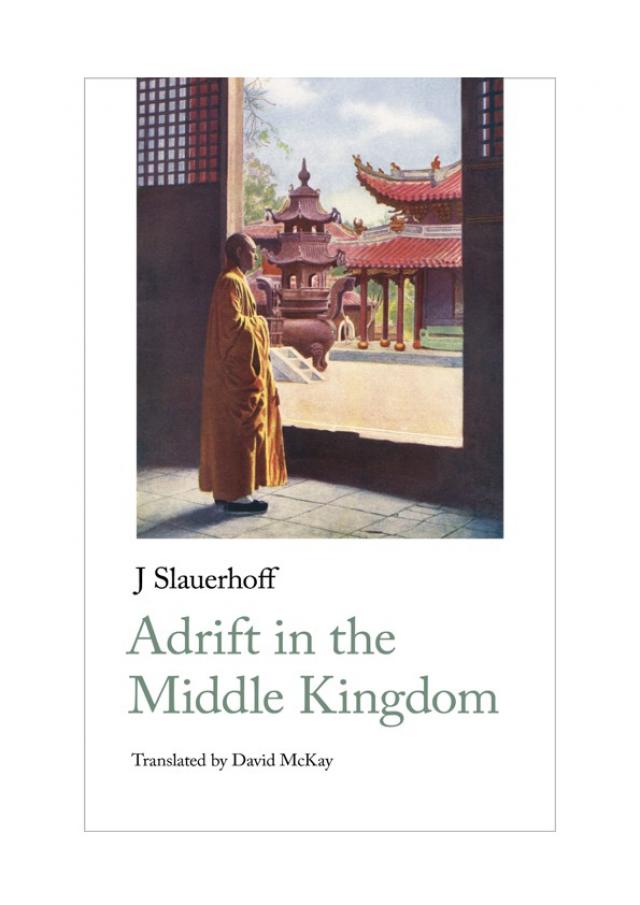
Adrift in the Middle Kingdom
Also published by Handheld Press
HANDHELD CLASSICS
1 What Might Have Been: The Story of a Social War, by Ernest Brash
2 The Runagates Club, by John Buchan
3 Desire, by Una L Silberrad
4 Vocations, by Gerald O’Donovan
5 Kingdoms of Elfin, by Sylvia Townsend Warner
6 Save Me The Waltz, by Zelda Fitzgerald
7 What Not. A Prophetic Comedy, by Rose Macaulay
8 Blitz Writing. Night Shift & It Was Different At The Time, by Inez Holden
HANDHELD MODERN
1 After the Death of Ellen Keldberg, by Eddie Thomas Petersen, translated by Toby Bainton
2 So Lucky, by Nicola Griffith
HANDHELD RESEARCH
1 The Akeing Heart: Letters between Sylvia Townsend Warner, Valentine Ackland and Elizabeth Wade White, by Peter Haring Judd
2 The Conscientious Objector’s Wife: Letters between Frank and Lucy Sunderland, 1916–1919, edited by Kate Macdonald
Adrift in the
Middle Kingdom
by J Slauerhoff
translated by David McKay
with an introduction by Arie Pos and Wendy Gan

First published in The Netherlands in 1934 by Nijgh & Van Ditmar as Het leven op aarde.
This edition published in 2019 by Handheld Press Ltd.
72 Warminster Road, Bath BA2 6RU, United Kingdom.
www.handheldpress.co.uk
Copyright of the Introduction © Arie Pos and Wendy Gan 2019
Copyright of the Translation © David McKay 2019
Copyright of the Notes © Kate Macdonald 2019
All rights reserved. No part of this publication may be reproduced, stored in or introduced into a retrieval system, or transmitted, in any form, or by any means (electronic, mechanical, photocopying, recording or otherwise) without the prior written permission of the publisher.
The moral rights of the authors have been asserted.
ISBN 978-1-9999448-7-2 Print
ISBN 978-1-9999448-8-9 ePub
ISBN 978-1-9999448-9-6 MOBI
Series design by Nadja Guggi.

Contents
Introduction
Slauerhoff and the novel
Slauerhoff and China
Works cited
Works by J Slauerhoff
Part One
Chapter 1
Chapter 2
Chapter 3
Chapter 4
Chapter 5
Chapter 6
Chapter 7
Chapter 8
Part Two
Chapter 9
Chapter 10
Chapter 11
Chapter 12
Chapter 13
Chapter 14
Chapter 15
Chapter 16
Epilogue
Notes
Arie Pos has lectured on Dutch literature and culture at the universities of Coimbra, Lisbon and Oporto, and is a translator of Portuguese literature into Dutch and vice versa. As well as a Portuguese translation of The Forbidden Kingdom he has published many articles and several books on J Slauerhoff and his work.
Wendy Gan is Associate Professor of English at the University of Hong Kong and the author of Fruit Chan’s Durian Durian (2005) and Women, Privacy and Modernity in Early Twentieth-Century British Writing (2009). Her latest book, Comic China: Representing Common Ground, 1890–1945 (2018) examines Anglo-American representations of China and the politics of humour.
Introduction
Slauerhoff and the novel
by ARIE POS
Jan Jacob Slauerhoff (1898–1936) is one of the most important writers of twentieth-century Dutch literature, and his poetry and prose continue to fascinate large numbers of readers. His short and troubled life was a restless quest for happiness, lasting love, a home and peace of mind, none of which he found. Born in Leeuwarden, the provincial capital of Friesland in the cold north of the Netherlands, he was asthmatic from an early age and could only breathe more freely during summer holidays on the island of Vlieland. The vitalising contact with the sea, the stories of seamen in his family and his passion for books about adventurous voyages and exotic cultures inspired a longing to travel and see the world.
He studied medicine at Amsterdam University from 1916 to 1923, and published his first poems in student magazines and literary reviews. After making sea trips to France and Portugal he decided to become a ship’s doctor. It seemed a good choice to get away from the cold and wet Dutch climate and the petty bourgeois society that he despised. His first collection of poetry, Archipel, was published at the end of November 1923 and a week after he took his Hippocratic Oath. In early 1924 he was on his way to the Dutch East Indies (modern Indonesia) to start a floating doctor’s life in the Far East. However, shortly before his arrival in Batavia (modern Jakarta) he suffered a lung haemorrhage, later diagnosed as a first sign of tuberculosis. He returned to the Netherlands to recover and worked for short periods as a locum before returning to Batavia, where he signed a contract with the Java-China-Japan Line in September 1925.
For two years he served as a doctor on the ‘coolie boats’ that transported Chinese plantation workers to and from Java and took other passengers and freight to Hong Kong and the ports on China’s south and east coasts. The ports he visited most frequently on the twelve journeys he made before his return to Europe in October 1927 were Hong Kong, Amoy and Shanghai. On some journeys the route included extra stops in the Philippines, Korea or Japan. Slauerhoff was able to leave his ship and visit the city or make small excursions inland. He took notes, kept a diary and wrote poetry and travelogues. His years in the Far East formed a major inspiration for his literary work; as well as poetry he wrote short stories and two novels set in China, the country that fascinated him throughout his life.
From 1928 to 1931 Slauerhoff worked on the luxurious Royal Holland Lloyd ocean liners, sailing from their home port of Amsterdam to South America. On his return he often had to recuperate from illness, and on one of his sick leaves in Holland he met the dancer Darja Collin, whom he married in September 1930. During another sick leave Darja gave birth to a still-born son in April 1932, a tragic event which affected Slauerhoff deeply and destabilised their marriage. Half a year later he started the first of five voyages to Africa as a doctor for the Holland West Africa Line.
Because of his health problems he often thought of giving up his work at sea and he looked for places with a more stable, warm and dry climate where he could settle as a doctor or consul, but his inquiries about possibilities in Shanghai, Lisbon, Barcelona, South America and Persia came to nothing. In 1934 he set up a private medical practice in Tangier but after half a year he gave it up and went back to Holland where his divorce from Darja Collin was granted. He returned to sea and travelled to South America and then to Africa. In Mozambique he contracted a severe form of malaria which, in combination with his tuberculosis, proved fatal. After a year of vain hopes of recovery in convalescent homes in Italy, Switzerland and Holland, Slauerhoff died in Hilversum on 5 October 1936 at the age of 38, three months after the publication of his last collection of poetry, which was ominously entitled An Honest Seaman’s Grave (Een eerlijk zeemansgraf). He published ten volumes of poetry, two collections of short stories, two novels and a play. A third novel appeared posthumously in 1937.
A large part of Slauerhoff’s poetry and prose is dedicated to the sea and the seaman’s life, situated in exotic settings, often featuring lonely wanderers trying to reach the unattainable on endless seas, in desolate deserts or amidst the ruins of a glorious past. Slauerhoff expressed his own romantic longing and disillusion with reality through transfigured images of pirates and desperados, and of explorers such as Christopher Columbus and the eighteenth-century Dutch explorer Jacob Roggeveen, military conquerors such as Genghis Khan and Napoleon, and the poets Baudelaire, Rimbaud, Verlaine, Corbière, Camões and Po chü-i. Taking liberties with biographical facts he recreated them as images of himself and his companions in misfortune. By inserting himself into the lineage of the French poètes maudits and of a Portuguese and a Chinese poet whom he pictured as equally doomed, unhappy wanderers and outsiders in a hostile world, he created his own many-faced muse whose inspiration was necessary but had to be carefully controlled to avoid his own identity being subsumed into those of his inspirations. This ‘struggle with the demon’ appears in many forms throughout Slauerhoff’s work, often linked to the central motif of ‘the hollow man’ who is looking for a way to fill the emptiness of his seemingly meaningless existence. Although there is no proof that Slauerhoff was acquainted with T S Eliot’s The Hollow Men and The Waste Land or Ezra Pound’s Personae, or the heteronymous poems of Fernando Pessoa, Slauerhoff’s handling of themes such as identity, alienation, depersonalisation and multiple personalities place him in the international tradition of modernism.
The same can be said of his pessimism about the future of Europe. Like many other authors and artists active after the First World War he felt that Western civilization was in decline and had lost its vital energy, becoming incapable of new achievements. This view was highly influenced by the compelling comparative study of cultures presented by the German philosopher of history Oswald Spengler in The Decline of the West (Der Untergang des Abendlandes, 1918–1922), which had become a widely read and much discussed international success. Spengler demonstrated tha
Slauerhoff considered himself a late-born and weakened descendant of Western culture doomed to live in decadent, degenerating and self-destructive times. These ideas come together in his two ‘China novels’ Het verboden rijk (The Forbidden Kingdom, 1932) and its sequel Het leven op aarde (Adrift in the Middle Kingdom, 1934). Here, the hollowness is not just a metaphor for the poet’s need for inspiration or an expression of romantic longing but an existential problem linked to the decline of Western culture. The main character in both novels is Cameron, a solitary man tired of his life as an outcast and hoping to free himself from his miserable self. He is a twentieth-century Irish-born ship’s radio operator but is not considered to be a real Irishman because he is said to have Celtic or Iberian forefathers. He has lost contact with his family, has no friends, no steady relationships and lives an isolated life at sea.
In The Forbidden Kingdom he is nameless, and suffers a mental crisis after surviving a shipwreck off the east coast of southern France. He feels empty, and starts recovering strange memories from the Portuguese past. He goes back to sea to work on boats in the Far East where the strange memories become stronger. Unknowingly he travels to places in and around the Portuguese enclave of Macao where the exiled sixteenth-century Portuguese poet Camões once lived. Gradually the spirit of Camões takes control of Cameron, and the two characters merge when Cameron arrives at the location in the Chinese desert where Camões had supposedly died. Their merged personalities separate again after their return to Macao: Camões lives on in the past and Cameron awakes in the present in a dirty Chinese hotel. He realises that he can’t escape from his fate by letting himself be demonised by a spirit from the past. He doesn’t want to return to sea, and decides to penetrate deep into China to either lose himself in the delights of opium or become an enlightened soul.
Cameron’s identity problem is set against the background of the cultural decline of Europe, Portugal and Macao in opposition to the unalterable immobility of ancient China. The struggle that he has with the spirit of Camões can be seen as a metaphor for the dangerous inspiration Slauerhoff sought through his identification with poets from the past.
In Adrift in the Middle Kingdom Cameron is identified by his name, suggesting that he has gained an identity. Why Slauerhoff gave him a Scottish rather than an Irish surname is not explained: he may have chosen Cameron because of its similarity to Camões. That he is Irish seems simply to have been due to Slauerhoff’s encounter with an Irish ship’s radio operator during his first visit to Macao around the New Year of 1927, where he made his first notes for The Forbidden Kingdom (Blok and Lekkerkerker 1985, 32–33). He also used Ireland’s nickname ‘the Emerald Isle’ and the name of the small islet next to Macao, Ilha Verde (Green Island), to indicate a connection between the lives of Camões and Cameron.
Between 22 October 1925 and 1 September 1927 Slauerhoff visited Shanghai nine times and stayed there in total for around thirty days. He made some friends in the city, including the French harbour pilot Paul Fouletier, to whom Adrift in the Middle Kingdom is dedicated, and his wife Claire, who lent some traits to the character of Solange. Their house in the French concession with its opium room inspired the description of the house of Hsiu in Chapter 3. In his diary Slauerhoff recorded opium sessions in their house, where he met two other Frenchmen, Sylvain and Godet (Slauerhoff 2012, 137–138, 145–146). Characters with the same names appear in chapter 3 in passages adapted from his diary. Slauerhoff smoked opium but, because he was asthmatic, breathing difficulties and coughing seizures often ruined the effects.
In the first four chapters Slauerhoff used many personal observations and experiences from his life aboard ship and his visits to Amoy and Shanghai, but the rest of the book was set in parts of China he had not visited. He fitted in experiences from elsewhere in China and other information gathered from a variety of printed sources, but not with the intention of giving a topographically and geographically accurate description of a journey from Shanghai (Taihai in the novel) up the Yangtze River and over land to Chungking. He used his sources mainly to collect Chinese terms and local colour, and to get information about landscapes, vegetation, the climate, the population, housing and local customs. Much of what he describes is easily recognisable as being close to the China of his day, but many places passed by the expedition to Chungking are not where Slauerhoff describes them as being. The most remarkable case is Chungking which he moved far to the northwest of Chongqing, not on the Yangtze River but on the Yellow River (Huang He). Slauerhoff constructed his fictional city with elements from a description and a map of Chengdu from the Géographie universelle (1927, tome IX, première partie), to which he added some features of what seems to be Liangzhou (modern Wuwei), an important old international trade city on the Northern Silk Road (Blok and Lekkerkerker 1985, 117–120 and 164–165).
The obvious name change of Shanghai to Taihai is an early warning to the reader about the fictional character of Chinese space in the novel. Slauerhoff selected and manipulated elements from Chinese reality and history to construct a virtual China which provides the symbolic setting for Cameron’s journey. His compact and terse style – considered edgy and unpolished but highly authentic by some of his critics – is charged with implicit meaning. Instead of telling and explaining Slauerhoff shows and suggests, creating a dream-like atmosphere where strong visual images of landscape and surroundings reflect Cameron’s state of mind and the stages of his quest. A modernist use of symbolisation, metaphor and allegory adds an extra dimension to the narrative, cutting it loose from realism and turning China into a metaphor for the Unknown or the Void that Cameron is confronted with after losing his social, religious and philosophical certainties.
The story is narrated mainly from Cameron’s first-person perspective, with the exception of the panoramic chapters 9, 11 and 16, the beginning of chapter 4 and Kia So’s letter to Wan Chen in chapter 10. Alienated in the foreign Chinese environment Cameron doesn’t have a clear view of the situations he is in or the people he meets; this causes his judgement to falter and raises doubts about his perception of reality. Despite his passive attitude his hope of finding a better life keeps him going, although he doesn’t know where it will lead him. Slauerhoff confronts Cameron’s existential hollowness and his struggle with emptiness with Buddhist views represented by Chinese characters who identify his attitude and facial features with those of oriental sages who live detached from the world. Kia So is frightened after seeing Cameron’s photograph sent by Hsiu to Chungking. He recognises the features of an anchorite and fears that this foreigner will bring destruction to the city. The Tuchun, on the other hand, is favourably impressed when he meets Cameron, and the monk Wan Chen guides and protects this foreigner, unbeknown to Cameron himself.
Hints and allusions earlier in the book suggest that Cameron has experienced Buddhist influences ever since his arrival in Taihai. When Cameron visits Hsiu’s house the Chinese merchant is pictured as ‘a fat, burly Chinaman with a smooth, pudgy face and a receding forehead that merges with his shiny scalp’ and later ‘seated at a desk as massive and ornate as an altar’: he looks like a statue of the Buddha (38 and 63). Hsiu is a criminal merchant but also, according to Solange, ‘a wise man’ who seems at home with Buddhist and Taoist wisdom and sends Cameron on a three months’ pilgrimage to a remote shrine high up in the mountains of Shantung before their journey to the interior begins. This immoral bandit-sage seems to be beyond good and evil, a possible echo of one of Friedrich Nietzsche’s thoughts about Buddhism that Slauerhoff – an interested and regular reader of his work – must have known: ‘Buddhism already has – and this distinguishes it profoundly from Christianity – the self-deception of moral concepts behind it – it stands, in my language, beyond good and evil’ (Nietzsche, 129). For Cameron the journey with Hsiu is a second stage on the Buddhist ladder after his friendship with Chu the watchmaker in the Taihai suburb, from whom he rented a room, and who believed life is continuous change ruled by the ‘wheel of existence’, the endless cycle of birth, life on earth, death and rebirth. That a person can free himself from this cycle and attain nirvana when they understand that mundane life is impermanent and that attachment to it is the cause of desire, suffering and pain, appears to be the message of the journey.






