

Eleutheria, p.1
Eleutheria, page 1


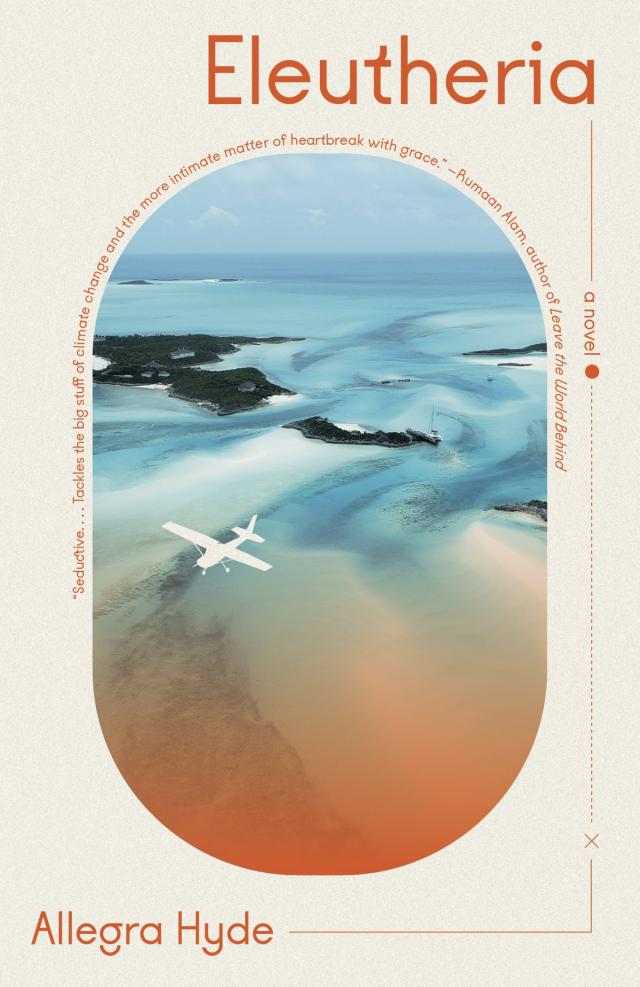
Advance Praise for Allegra Hyde’s
Eleutheria
“Eleutheria is gripping, surprising, and full of the poetry of planet Earth. This book is a marvel.”
—CJ Hauser, author of The Crane Wife: A Memoir in Essays
“Eleutheria’s timeliness alone is enough to justify a wide and appreciative audience, yet Hyde’s exceptional artistic gifts—especially the complex characters and charged language—make this novel’s urgent concerns all the more powerful.”
—Ron Rash, author of In the Valley
“My god, can Allegra Hyde write! Eleutheria is a thrilling and utterly transporting novel about survival and hope and the tenacity of love in a dying world. Hyde’s characters are unforgettable, her sentences crystalline. I was surprised and delighted and moved at every turn.”
—Kirstin Valdez Quade, author of The Five Wounds
“With her captivating novel, Allegra Hyde leads us on a willful, sinuous search for answers in an upended world. Eleutheria is a rallying cry for our collective change of direction.”
—Pitchaya Sudbanthad, author of Bangkok Wakes to Rain
“Eleutheria is utopian writing at its best and boldest…. Every sentence Allegra Hyde writes is alive with grace and power and enviable moral clarity.”
—Matt Bell, author of Appleseed
“Incisive, darkly funny, and farseeing…. A stunning debut.”
—Vanessa Hua, author of Forbidden City and A River of Stars
“Clear-eyed, buoyant, and far-reaching…. I read Eleutheria in one breathless day and was sorry to leave this world, where our mistakes and tragedies are shown to be as fully human as our most generous dreams.”
—Adrienne Celt, author of End of the World House
“Allegra Hyde’s visionary first novel is like a terrarium, a small new world made by someone who cares deeply about our survival…. But far from being a closed system, everything inside this book—both the ecological disasters and their elegant solutions—is an invitation, radiant with possibility, asking us with love and urgency to change.”
—Jennifer Tseng, author of Mayumi and the Sea of Happiness
“A twisty, startling tale of climate change and utopia more than worthy of all its ambition. I wept when it was over, for Willa, but also for this mess we’re in—a mess Hyde illuminates with beautiful, affecting prose, bizarre characters who are so completely themselves, and plot twists that shock even as their root is in the inevitability of generations of selfishness. This is a haunting book about reckless, heartbreaking hope.”
—Lydia Conklin, author of Rainbow Rainbow
“Vivid. Wry. Exceptionally clear-sighted.”
—Morgan Thomas, author of Manywhere
Allegra Hyde
Eleutheria
Allegra Hyde’s debut story collection, Of This New World, won the John Simmons Short Fiction Award through the Iowa Short Fiction Award series. Her stories and essays have appeared in The Pushcart Prize, Best of the Net, The Best Small Fictions, and The Best American Travel Writing. Originally from New Hampshire, she currently lives in Ohio and teaches at Oberlin College.
A VINTAGE BOOKS ORIGINAL, MARCH 2022
Copyright © 2022 by Allegra Hyde
All rights reserved. Published in the United States by Vintage Books, a division of Penguin Random House LLC, New York, and distributed in Canada by Penguin Random House Canada Limited, Toronto.
Vintage and colophon are registered trademarks of Penguin Random House LLC.
This is a work of fiction. Names, characters, places, and incidents either are the product of the author’s imagination or are used fictitiously. Any resemblance to actual persons, living or dead, events, or locales is entirely coincidental.
Library of Congress Cataloging-in-Publication Data
Names: Hyde, Allegra, author.
Title: Eleutheria / Allegra Hyde.
Description: First Vintage Books edition. | New York : Vintage Books, 2022.
Identifiers: LCCN 2021032415 | ISBN 9780593315248 (trade paperback) | ISBN 9780593315255 (ebook)
Classification: LCC PS3608.Y365 E44 2022 | DDC 813/.6—dc23
LC record available at https://lccn.loc.gov/2021032415
Vintage Books Trade Paperback ISBN 9780593315248
Ebook ISBN 9780593315255
Cover design by Madeline Partner
Cover photographs: sea © Daniel Piraino/EyeEm/Getty Images; plane © Mark Tr/Shutterstock
www.vintagebooks.com
ep_prh_6.0_139403815_c0_r0
Contents
Cover
About the Author
Title Page
Copyright
Dedication
Epigraph
[My father had a theory…]
Chapter 1
[They were elsewhere…]
Chapter 2
[In a cave open wide as a scream…]
Chapter 3
[Word swept like wildfire…]
Chapter 4
[With an insect’s instinct…]
Chapter 5
[Another body…]
Chapter 6
[Power grab…]
Chapter 7
[Moonlight glinted on their muskets…]
Chapter 8
[Call them parasites…]
Chapter 9
[In the hush of waiting…]
Chapter 10
Acknowledgments
For my parents
That their jurisdiction shall reach only to men as men, and shall take care that justice, peace, and sobriety, may be maintained among them. And that the flourishing state of the republic may be by all just means promoted.
—Articles and Orders of the Company of Eleutherian Adventurers, 1647
The space between the idea of something and its reality is always wide and deep and dark.
—Jamaica Kincaid, 1991
My father had a theory for why people went to the ocean in the summer, spent their savings, their vacation days, to plant themselves on a patch of sand within sight of the water.
Even if they don’t know it, my father said, what they want is to be close to death.
That’s what going to the ocean was, according to him: a chance to strip down and expose yourself to danger. To risk sunburn and dehydration and errant strikes of lightning, the foot-slice of seashells, sand-submerged needles. At the beach, you could wade out into waves that might pull you into a riptide or the jaws of a shark. Or even if you only dipped your toes in the water, you’d still know you were stepping into something so vast it could engulf you, swallow you whole.
It’s not that people want to die, said my father, it’s just that when they go to the beach a part of them knows, deep down, that they could. So afterward, when they return to their three-hour commutes and their cubicles, they return with a secret sense of survival. They feel woken up. More alert.
My mother snorted when she heard this. She, like my father and I, was crouched in the dark gut of our emergency bunker—yet unfinished, but stocked with canned goods, blankets, a stack of semiautomatic rifles. We were practicing what to do in the event of an electromagnetic attack.
Going to the beach, said my mother, won’t save you when S-H-T-F.
My parents didn’t think we needed the beach because, unlike the masses, we were already alert to the horrors and dangers of the modern world. Unlike the masses, we were already prepared.
So, I didn’t go to a beach until I was nearly eighteen, and then it was only a shabby artificial one near Logan Airport. I didn’t go to a beach until after my parents couldn’t survive themselves.
And when I went with Sylvia, that felt different—not like pressing in close to death, but already existing in an afterlife.
Really, my father’s theory didn’t mean much to me until these last eight months, the ones I’ve had to think through what happened on the island, what happened at Camp Hope. All this time I’ve had to wonder what it was we were really doing—what it was I did—and now, of course, I have hardly any time at all.
Maybe I should have been thinking of my father right from the beginning. Maybe I should have thought about where I was really going when I first careened over the archipelago in a turboprop gunshot from Florida, and those islands looked to be all beach, the Bahamas scattered along the turquoise lip of the Caribbean, their coastlines sandbar-swirled, coral-dazed, the islands so low in the water they seemed poised to hold their breath. A little more sea-level rise and they’d be washed away. Already their edges were eroding, ocean swells grabbing at coastal roads, at the underbellies of beach houses not yet leveled by hurricanes. The worst of the storms had turned whole resorts to matchsticks, their swimming pools gone green from neglect, pagodas engulfed by vegetation, hibiscus blooming in marbled bathrooms, quail doves shitting on embroidered towels—another empire born and bowed—and yet when I looked down from the turboprop, pressed my face to its oval window, I felt only possibility. I felt more than alive.
My whole life I’ve run away from my parents’ way of thinking; that’s what I wish people understood. Despite everything that has happened—the way everything looks—I only ever wanted to make the world better. I only ever wanted to
You should know, too, that I recognized Eleutheria from the air. I knew the island even before the turboprop circled toward a ragged stretch of tarmac. The island bathed in the water like a fishhook: a skinny hundred miles that curved at one end, its shorelines barbed by peninsulas, baited with the green sway of sea grapes, beaches as pink and fine as spun sugar.
I felt Eleutheria catch my heart—and pull.
1
My name, my full name, is Willa Marks. There’s nothing in the middle. My parents must have had their reasons for the omission, though I’ve always considered it a sign of honesty. A middle name can lurk in a person like a bomb: a secret identity poised to pop off. I’m simply me.
What I’m trying to say is that I’m going to tell you the truth. I don’t have time to tell you anything else. And it’s important for you to hear the truth because what has been said about Camp Hope, about me, is a shadow of what really happened.
Let me start with the easy parts.
I was twenty-two when I boarded a plane and flew to Eleutheria.
I was drunk on ideas.
I was so drunk, in fact, that when the turboprop shuddered into a nosedive—cabin lights flickering, pilot crackling over the intercom—my limbs remained limp. While the other passengers hunched in their seats, prayers on their lips, I kept my eyes open, savoring the rush of arrival, the jarring smack of it reverberating through me.
The turboprop did not land elegantly, but it landed intact. Even so, had the plane crashed onto the island, I’d still have walked out of the wreckage, beatific. I’d been awake the length of a day, a night, and that had not yet become a problem. I was the kind of person who took exhaustion in stride, let it warp my surroundings into dreamscapes. And so far, everything had gone right.
Out the airplane window: palm trees, a heat-seared tarmac, men in orange vests strolling from the steel maw of a rusted aircraft hangar. Around me, a dozen other passengers unbuckled their seat belts. Some smiled relievedly, others wiped away tears. A woman’s purse had spilled into the aisle and I helped her collect her things, though I curbed my impulse to ask if she was from Eleutheria. To get caught in conversation might break whatever spell had whisked me from Boston to the Bahamas, a spell meant to carry me on to Camp Hope. I wanted to arrive unimpeded, unburdened, slick as a fish released into the sea. If I could have, I would have traveled to the island naked. As it was, my backpack contained only a change of clothes, a passport, sixty-five U.S. dollars, and my well-thumbed copy of Living the Solution: The Official Camp Hope Guide to Transforming Ourselves and Saving the Planet.
I had the envelope as well—the one from Sylvia—but I tried not to think about it.
What I thought about was Camp Hope. Specifically, about arriving at Camp Hope and making my life mean something. Had you watched me exit the airplane, my preoccupation would have been obvious. You would have seen a young woman who tripped over her own boots—a size too large—as she entered the hangar. You might have noticed one of my overall cuffs was rolled up higher than the other, that my backpack zipper gaped partially open. Back in Boston, I would have been a person your eyes glazed over on the street: shiftless, among the masses of the newly unemployed. I had an oval face, brittle yellow hair that went dark at the roots, a stub of a nose. I was thin, but not jagged. Scrappy, though in an untested way: like a runaway who has only just left the house, or an actor playing a role. Familiar enough to forget.
In the echoing dimensions of the hangar, however, I stood out. I’d traveled to the island alone and there was no one there to meet me. I had little luggage. I was white and the only person queued in the International Arrivals line. A weary customs agent took my passport, studied it, shrugged. There were no biometric scanners here. Not in this makeshift terminal, arrivals separated from departures by a plastic partition. The original building, like so much else on the island, had been ravaged by hurricanes. Under different circumstances, I might have been made teary-eyed by the scene of my fellow passengers embracing loved ones, opening luggage to reveal supplies from elsewhere—bags of dried rice, baby clothes, phone chargers—but I fixed my attention on the airport exit: a square of sunshine on the far side of the hangar.
I have what you could call a tendency toward fixation. This tendency has been described as childish by some. People have told me, in general, that I have a childlike demeanor. My short stature is partly to blame. Also, my smattering of freckles—though these would multiply, day by day, colonizing my complexion the longer I remained on Eleutheria. I did not have any muscle tone, though that would change as well. I had little coordination. I have only ever been graceful in photos. Pinned under someone else’s gaze, I look best in stillness.
I was not still. Walking with rollicking, over-long strides, I burst out of the hangar into dazzling sunshine. A parking lot shimmered, woozy with heat, its perimeter rimmed by a chain-link fence. In the distance, a narrow highway disappeared into a low swath of scrubland.
My skin burned hot; I had Living the Solution churning inside me and with it the heat of my own ambition. I tended to flush in odd ways—in my fingertips, mostly—though if you’d been watching, this would have been invisible. You would have seen only a pale girl striking out across a parking lot. A lost girl, harmless—or even in harm’s way—easily manipulated. A rube. It was true, my official education extended only through high school, homeschooled at that. But I was not entirely inexperienced. At twenty-two, I’d had my own unusual education. I considered myself intellectually advanced in one significant way: I was too wise for cynicism. I had outsmarted doubt.
No one at Camp Hope knew I was coming. No one would know who I was when I arrived. I maintained, nevertheless, a propulsive confidence. Reaching the edge of the parking lot, I started down the side of the highway, soaking in sunshine, electrifying my body, intending only to move closer to my destination—a place in my head, rather than direct view—so that, if you’d been watching, you might have seen my eyes go unfocused, my chin lift, my chest tugged forward by an invisible string.
Someone was watching. A pickup truck trailed me out of the parking lot and onto the highway. There were four men in the truck: two in the front and two in the back. The pair in the back wore sun-faded T-shirts that billowed in the breeze, their arms stretched along the edges of the truck bed. The man in the passenger seat wore an orange vest, as if he’d just stepped off the airport tarmac. The driver was obscured.
I kept walking and the truck kept rolling, until the man in the orange vest called: You a surfer? Or—
A fugitive? interrupted a man in the back.
There was laughter, but I didn’t care—I didn’t even break stride. In my mind’s eye, my destination glittered: an ecoparadise, a pragmatic arcadia, an answer to the problem that had haunted me my whole life.
Are you lost? said the man in the orange vest.
Though I’d barely spoken for a day and a half, my answer burst forth, bell-like and bright: I’m going to Camp Hope.
The truck stopped rolling. The men’s laughter ceased. I continued on, unperturbed, reciting lines from Living the Solution beneath my breath, swinging my arms as I walked the ragged edge of the highway.
Ten minutes later, the truck again rumbled alongside me. All the men had gotten out except the driver. He leaned across the passenger seat, his face visible for the first time. He was handsome in a plaintive way, his eyes half-closed, his jawline shadowed by a beard, his dreadlocks pulled behind his head. He asked if I was really going to Camp Hope.
Sure am, I said.
Camp Hope is far, far from here, he said.
I can manage, I said—though in truth it was hotter than seemed possible for the month of May. Only squat palms and brambly foliage stretched before me, with no sign of a settlement or even the sea, save for the wheeling arc of a gull overhead.






