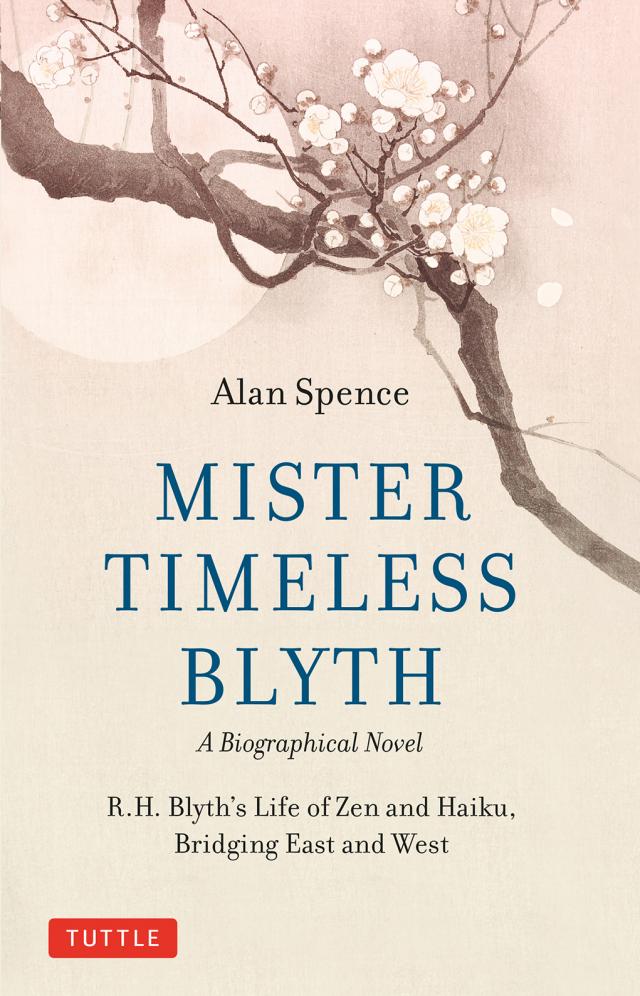
Mister timeless blyth, p.1
Mister Timeless Blyth, page 1


“Books to Span the East and West”
Tuttle Publishing was founded in 1832 in the small New England town of Rutland, Vermont [USA]. Our core values remain as strong today as they were then—to publish best-in-class books which bring people together one page at a time. In 1948, we established a publishing outpost in Japan—and Tuttle is now a leader in publishing English-language books about the arts, languages and cultures of Asia. The world has become a much smaller place today and Asia’s economic and cultural influence has grown. Yet the need for meaningful dialogue and information about this diverse region has never been greater. Over the past seven decades, Tuttle has published thousands of books on subjects ranging from martial arts and paper crafts to language learning and literature—and our talented authors, illustrators, designers and photographers have won many prestigious awards. We welcome you to explore the wealth of information available on Asia at www.tuttlepublishing.com.
Published by Tuttle Publishing, an imprint of Periplus Editions (HK) Ltd.
www.tuttlepublishing.com
Copyright © 2023 by Alan Spence
All rights reserved. No part of this publication may be reproduced or utilized in any form or by any means, electronic or mechanical, including photocopying, recording, or by any information storage and retrieval system, without prior written permission from the publisher.
Library of Congress publication data is in progress.
ISBN: 978-0-8048-5635-5
ISBN: 978-4-8053-1757-0 (for sale in Japan)
ISBN: 978-1-4629-2361-8 ebk, 1(2211IN)
26 25 24 23
10 9 8 7 6 5 4 3 2 1 2211CM
Printed in China
Distributed by
North America, Latin America & Europe
Tuttle Publishing
364 Innovation Drive
North Clarendon, VT 05759-9436 U.S.A.
Tel: (802) 773-8930; Fax: (802) 773-6993
info@tuttlepublishing.com
www.tuttlepublishing.com
Japan
Tuttle Publishing
Yaekari Building 3rd Floor
5-4-12 Osaki Shinagawa-ku
Tokyo 141 0032
Tel: (81) 3 5437-0171 Fax: (81) 3 5437-0755
sales@tuttle.co.jp
www.tuttle.co.jp
Asia Pacific
Berkeley Books Pte. Ltd.
3 Kallang Sector
#04-01, Singapore 349278
Tel: (65) 6741-2178; Fax: (65) 6741-2179
inquiries@periplus.com.sg
www.tuttlepublishing.com
TUTTLE PUBLISHING® is a registered trademark of Tuttle Publishing, a division of Periplus Editions (HK) Ltd.
Contents
1 Timeless
2 Land of Morning Calm
3 But a Dream
4 Light of the Fireflies
5 Persons in a Belligerent Nation
6 Eight Times Up
7 Destroyer of Worlds
8 Gakushuin
9 Declaration of Humanity
10 The Music of What Happens
11 This Very Place
12 Barbaric Yawp
13 Sacred Treasure
14 The Spaces Between
15 Blyth’s Shadow
To
DAISUKE MATSUNAGA
with gratitude
1
TIMELESS
Blyth.
The Japanese pronounced it Buraisu.
Buraisu-san.
Suzuki-sensei had sent me a letter, the name spelled out on the envelope in his elegant, vigorous calligraphy, at once delicate and bold, unmistakeable.
This, Suzuki explained, had three meanings.
First, a simple rendition of my name in Chinese characters. Bu-Rai-Su.
Second, it meant Not-Come-Person. In other words, You have not come to see me in a long time.
Third, it could mean You are not-coming, not-going, not-born, not-dying. You are Mister Timeless Blyth.
How I signed myself thereafter.
Mister. Timeless. Blyth.
RH Blyth.
Reginald Horace.
This particular incarnation of my timeless self took birth on December 3rd 1898. Fin de siecle. I was a child of the Nineteenth century, though only just – born in a modest house in Leytonstone, South East London. 93 Trumpington Road, to be exact – a splendidly English-sounding street name, I always thought, comically pompous and overblown. Trumpet. Trumpery. Trumpington.
Trumpington Road. East Eleven.
Equally English were those names with which I was christened. Reginald Horace. Reginald Horace Blyth of Trumpington Road.
The house overlooked two cemeteries, one Christian, one Jewish. That might account for the strong sense of mortality I possessed – though I was never a morbid child – and the sense too that religion was not something absolute: it came in many forms. (For a time my father, God bless him, took us to the mission hall of a rather fundamentalist sect, where he sometimes read the lesson or led a hymn. Give me oil in my lamp…) There was a certain melancholy beauty in walking through those graveyards. Whatever the trappings, it ended here. Dust to dust. I read the inscriptions on tombstones, each one a memento mori, carved in stone.
Thou painted piece of living clay,
Man, be not proud of thy short stay.
The sense of transience was never far away. Time’s winged chariot hurrying near.
There’s something I’ve observed that always unsettles me. On the title page of a book, in the small print under the publishing details, it gives the author’s name and dates. Wordsworth, William (1770-1850). Arnold, Matthew (1822-1888). So there it would be: Blyth, Reginald Horace (1898- ) The name, the date of birth, the blank space waiting to be filled in. The brackets closed.
I may not know the date, but I know where I will be buried. I can visit my own grave. (The last time I did so was on a fine spring morning, earlier this year, the cherry blossoms already in bloom). I chose the site myself, bought and paid for it years ago. I will rest alongside Suzuki-sensei who has also reserved a place. It is in the graveyard at Tokeiji temple near Kamakura, and Suzuki’s wife is already buried nearby. I hope I am not tempting the fates, the furies, the angry gods, by saying I hope I have just a little more time before my passing.
I cycle to Tokeiji from Kita-Kamakura, alongside the railway track, and leave my bicycle at the gate. The climb to my grave is long and steep, an arduous ascent with steps to the highest level of the cemetery. Recently I’ve found myself having to stop halfway to draw breath and gather my strength.
Another neighbour in my long rest will be the philosopher Tetsuzo Tanikawa, who has also booked his little plot of land. He was born before me, and, like me, he is still on earth.
Tanikawa, Tetsuzo (1895- ).
He is a good man, and will be amiable company. His date of departure too will be carved in stone, as mine will be soon enough. Soon enough.
The haiku poets all wrote a jisei, a death verse. In fact I have often thought that every good haiku, every true poem, is a kind of death verse.
I have already written mine, or one that will suffice.
It begins,
We that change,
Hate change.
It ends:
Ashes,
Darkness,
Dust.
But on re-reading, perhaps it is rather self-consciously portentous with its dying fall. (Its dying fall!) I may substitute an unattributed haiku which was recently drawn to my attention. I like the fact that it is anonymous. It was written in Japanese, and I have made my own translation.
Sazanka ni kokoro nokoshite tabidachinu
I leave my heart
to the sasanqua flower
on the day of this journey
Sasanqua flower. Tokeiji temple. It is all a far cry from Leytonstone
My father worked as a clerk for the Great Eastern Railways, and that gave me access to the station platform – after school and on Saturday afternoons – where I supplemented the family income by selling bars of chocolate to passengers. I was a strong boy – stocky and robust, not easily knocked off my stride. The speed and resilience I’d developed on the running track and the rugby field stood me in good stead as I ran and jinked along the platform. An artful dodger. The best time was rush hour when the platform was crammed, chocabloc. (Chocabloc for chocolate blocks!) I’d be blocked and buffeted as I shouldered my way along, touting my wares, shouting out the prices in best barrow-boy style.
Get yer chocolate bars here, only tuppence the quarter-pound!
The trains ran to and from Liverpool Street, or in the other direction, Southend-on-Sea. (Southend with its sandy beach and mile-long pier – we’d go there on a rare outing, on some long summer Sunday – God, so long ago now – with free tickets my father had acquired).
I’d be braced and ready as a train pulled in, engulfed in its own smoke and steam, wheels grinding and screeching to a halt, sparks and cinders thrown into the air. The doors would be flung open and, it seemed, hundreds of men would disembark or push their way on. And yes, the passengers were almost all men, on their way to work, or on their way back, and all, as I remember it, in workday suits and coats, and wearing hats – tweed caps, bowlers, even top hats for those that travelle
I’d push through the crowds, keeping my balance. I’d be cursed and sometimes shoved by some irate commuter, anxious not to miss his train. But somehow enough of these men would stop and buy, and we kept the enterprise going, even though it can’t have made much money.
I suppose my father bought the chocolate from a wholesaler, perhaps somebody he knew. It was always the same two varieties in simple chunky bars – Dairy Milk and Bourneville, the one pale and creamy, the other deep and dark. I ate both, equally greedily, but I knew which I preferred – the dark one, bittersweet, in its red wrapper.
My mother said I ate all the profits, and it was true I scoffed the odd bar to keep me going. My father would say, He’s a growing boy, and she’d say that was true, especially around the waist. But the love of chocolate never left me.
On one of my first visits to the Imperial Palace in Tokyo, Her Majesty Empress Kojun sought to put me at my ease by commenting on my girth. Mister Buraisu, she said, smiling. You are very fat.
Nonplussed, I nevertheless gathered myself and replied that it must be because of my vegetarian diet. Even elephants, I said, which eat nothing but leaves, grow to an enormous size. The Empress, who had been described to me as somewhat reserved, laughed and repeated my remark to one of her attendants.
An elephant! she said, delighted.
Thereafter the Empress greeted me with friendliness and a kind of wry amusement.
An English elephant in a tweed suit.
Some rogue incarnation of Ganesha, perhaps, the Hindu god of wisdom, with his pot belly and his elephant head.
That cartoon character in the little French books my daughters read. Histoire de Babar. I read it aloud to them and translated as I went.
My daughters, Nana and Harumi.
How did it all come to pass? How did I come to end my days here in Japan? How did I get from Trumpington Road to the Imperial Palace? Why did Bodhidharma come from the West?
Suzuki-sensei would have some profound non-answer.
Why did Buraisu-san come from the West?
Suzuki-sensei taught me not to teach. He taught me everything I don’t know.
I began making these notes at my home in Oiso before the illness took hold, before I was brought to hospital. I wrote in my bright study, overlooking the garden, surrounded by my books and papers – a lifetime’s accumulation, my own library and archive. I sifted through old notebooks and diaries, letters, newspaper cuttings. The dross and residue of a life, of this life.
My home in Oiso. There is an outhouse I built myself, round a living tree that grows up through the roof, its branches reaching towards the sky.
There are days when I fear I may never see the house again, that this is the end.
I am writing this introduction, as I have written the rest of these pages, on sheets of old lined paper, foolscap size. The pages are yellow, like the paper I used for the drafts of the Emperor’s speech in 1945. Ningen Sengen. Declaration of Humanity.
Novel on Yellow Paper. That was by the English poet Stevie Smith. I picked up an old paperback copy, years ago. The things that lie buried in the memory, only to float to the surface, unbidden. Smith wrote that remarkable poem ‘Not Waving but Drowning.’
I remember, word-for-word, the very beginning of her novel. I should like then to say: Goodbye to all my friends, my beautiful and lovely friends. And for why? Read on, Reader, read on and work it out for yourself.
Indeed. This is my Goodbye.
Read on.
I have always written, though not about myself. Why would I do that? A shilling life would give you all the facts, if such a thing existed. But it does not, and if it did, of what interest would it be? What purpose could it possibly serve? So why, now, these scribbled notes, on yellow paper?
Why this, why that? Why anything?
Let me put it simply. In my life I have followed what felt like an inner destiny. This predisposed me to pass through a number of phases which were not, however, mutually exclusive. In coming to an understanding (or un-understanding) of these phases, I have written extensively and continuously.
In my time, I have been prolific. The list of my books is long and I believe, in their way, they have been influential, though my critics have accused me of being a mere anthologist, lacking proper scholarship and academic discipline. To which I might reply that they misunderstand my intention, and leave it at that. (I have also been called problematic and terminally eccentric. I would accept either description as a compliment!)
When I’m too tired to read or write, I can sometimes listen to the radio. The nurses are kind and help me tune it to different stations. Most of the broadcasts that come through are Japanese, and I just let it wash over me. But sometimes there’s an American Forces network, or the BBC World Service, and increasingly there are reports from across the South China Sea in Vietnam.
There had been an incident in the Gulf of Tonkin where an American destroyer came under attack. As a result, a US resolution was passed paving the way for the deployment of ground forces, a strategic bombing campaign, the declared intention being to contain the spread of communism. It’s hard to make sense of it, if any sense can be made. But whatever the rhetoric, it is about ideology and power, the control of resources.
It’s Korea all over again and may be even bloodier. I remember the boy Lee and what became of him, and I find I have tears in my eyes.
There are students and Buddhist monks protesting in the streets. The newspapers carried that photograph of the monk who sat down calmly in the centre of Saigon, and had petrol poured over him. Then deliberately, with absolute focus, he struck a spark from a cigarette lighter and was engulfed in flames.
Some film crew managed to record it and it was broadcast on television news, again and again. The monk seated in meditation as the fire consumed him.
His name was Thich Quang Durc. He was protesting against the treatment of Buddhists in the South. He chanted Nam Mo A Di Da Phat, the Vietnamese form of Namu Amida Butsu. Homage to Amitabha Buddha.
He was the same age as me, going on sixty-six. Close to the allotted span. Three score and ten. When a younger monk offered to take his place, he pulled rank. It was a matter of seniority. The right to self-immolation was his and his alone. He stepped from the back of a saloon car which had brought him to the place. A hundred other monks formed a circle around him, praying and chanting as he set himself alight.
His body swayed and wavered in the flames. It blackened as he burned, and gave off a thick oily smoke.
Namu Amida Butsu.
I bow to the Buddha of the Pure Land.
The Buddha’s Fire Sermon.
All is burning. And what is the all that is burning?
All forms are burning.
Burning with what?
Burning with birth, ageing and death.
The whine and crackle of static on the airwaves, the old radio struggling to maintain a steady signal. Then suddenly there’s a clear passage of my beloved Bach. It sounds like the Goldberg Variations, the version by Glenn Gould. I have the recording – the one where Gould can be heard singing along, to the outrage of most purists. I find it glorious and anarchic and utterly human. It makes me smile.
In spite of it all, in the face of it all, there is this. This is still possible.
But don’t you know there’s a war on?
Sadly, there always is.
All was far from quiet on the Western Front. The Great War, the War-to-end-all-wars, was running its bloody course – carnage and mass slaughter on an unprecedented scale. Between Verdun and the Somme there were a million dead. Blown to bits or drowned in mud or poisoned with chlorine gas.
Your Country Needs You.